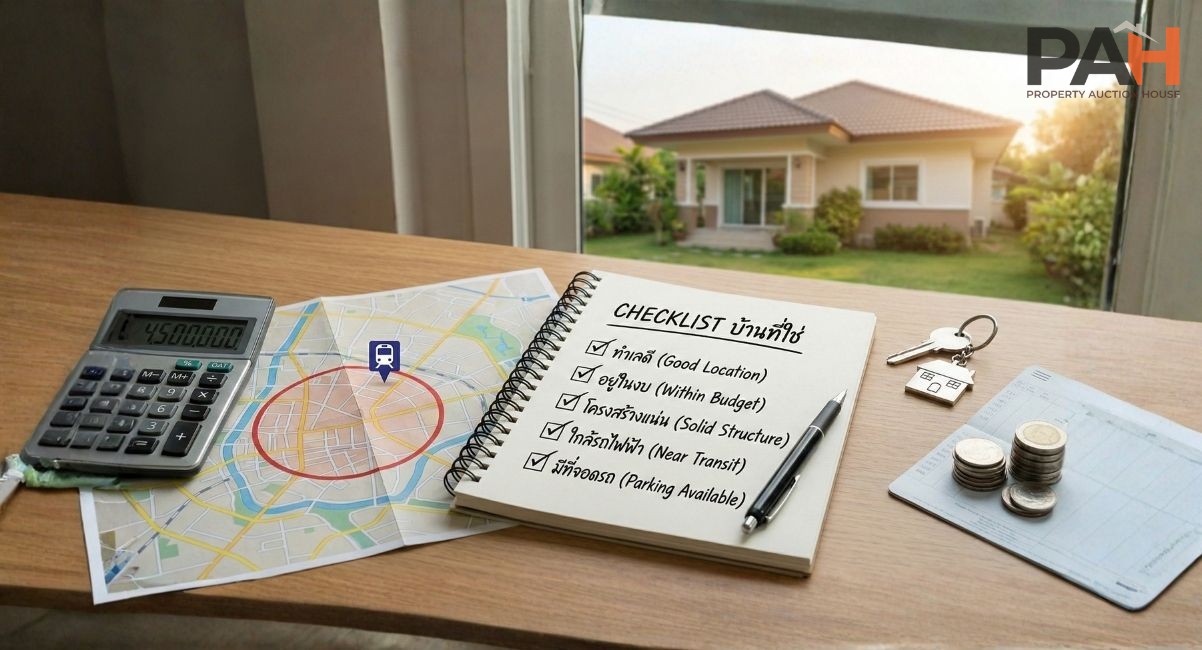
What Is Auction Property Investment?
Auction property investment refers to purchasing real estate sold through a legal enforcement or foreclosure auction process.
In Thailand, most auction properties come from court enforcement procedures and are sold as-is, where-is, often at prices below open market value.
Unlike normal property transactions, auction properties:
Do not offer warranties
Do not allow negotiation after the auction
Require buyers to accept legal and physical conditions stated in the auction announcement
Why Are Auction Properties Cheaper Than Market Price?
Auction properties are sold at discounted prices because:
Sellers are enforcing debt recovery through legal procedures
Buyers must accept risks related to property condition, access, and occupancy
There are no guarantees or post-sale negotiations
The lower price represents risk compensation, not a defect in value.
Are Auction Properties Suitable for Foreign Investors?
Auction properties can be suitable for foreign investors who understand the legal structure and ownership restrictions.
Foreign investors commonly invest by:
Purchasing through a legally structured company
Investing in eligible property types
Using auction properties for resale (Flip) or rental income
Professional legal and title checks are strongly recommended before bidding.
Is Auction Property Investment Suitable for Beginners?
Yes — if beginners start with low-risk assets.
Beginner-friendly auction properties typically:
Are vacant (no occupants)
Have no complex legal encumbrances
Are located in liquid markets (urban or suburban areas)
Properties with multiple claims, severe deterioration, or no access for inspection are not suitable for beginners.
What Type of Auction Property Should Beginners Start With?
Beginner investors should focus on:
Standard houses or townhouses
Properties near main roads, business districts, or residential communities
Assets with clear resale or rental demand
These properties are easier to evaluate externally and easier to exit.
How Much Capital Is Required to Invest in Auction Property?
Capital requirements vary by location and asset type.
As a general guideline:
Provincial areas: starting from lower price ranges
Major cities: higher capital requirements
Investors should prepare an additional 20–30% buffer on top of the purchase price to cover:
Renovation costs
Legal fees
Transfer fees
Holding costs
What Is Property Flipping Using Auction Properties?
Auction property flipping means:
Buying below market value
Renovating or improving the property
Reselling for profit based on price spread
Successful flipping depends on total cost control, not just buying cheap.
Is Auction Property Flipping Profitable?
Yes — when executed correctly.
Professional investors typically apply this rule:
Total investment cost should not exceed 60–70% of the realistic resale market price
Buying too high at auction often eliminates profit, even after renovation.
How Much Renovation Budget Should Be Reserved?
If internal inspection is possible: 10–20%
If inspection is limited or impossible: 20–30%
Underestimating renovation costs is one of the most common reasons auction investments fail.
How Long Does It Take to Sell a Flipped Auction Property?
Typical timelines:
Good locations, market pricing: 3–6 months
Secondary locations or overpriced assets: 6–12 months
Holding time must be included as a financial cost in the investment plan.
Are Auction Properties Suitable for Rental Investment?
Auction properties can generate strong rental returns if:
Acquired significantly below market value
Rental income covers ownership, maintenance, and vacancy risk
They are not suitable if:
Rental demand is weak
Purchase price is too high relative to achievable rent
What Is a Good Rental Yield for Auction Properties?
General benchmarks:
Below 4%: Low attractiveness
4–6%: Acceptable
6%+: Strong rental investment
Always calculate yield using net rental income, not projected rent.
What Type of Auction Property Is Easy to Rent?
Properties that rent easily usually:
Are close to workplaces, universities, hospitals, or transport hubs
Offer practical layouts and livable conditions
Avoid over-renovation that increases rent beyond market acceptance
Tenants prioritize comfort and price over luxury.
Common Mistakes Made by Auction Property Investors
Common mistakes include:
Focusing only on auction price, ignoring total cost
Entering auctions without a maximum bid limit
Underestimating selling or rental timelines
Disciplined investors who control budgets and avoid emotional bidding tend to succeed long term.
Final Advice: How to Invest in Auction Property Safely
Auction property investment is not gambling — it is a system-driven strategy.
Successful investors:
Understand auction announcements
Assess legal and physical risks
Calculate full investment costs
Set a strict maximum bid before auction day
When done properly, auction property can be a powerful and sustainable investment tool.