2026 Transit Line Map: Investing in High-Potential Locations Near New Stations
Analyzing upcoming and under-construction transit routes to identify high-potential areas for real estate investors.
Short Answer
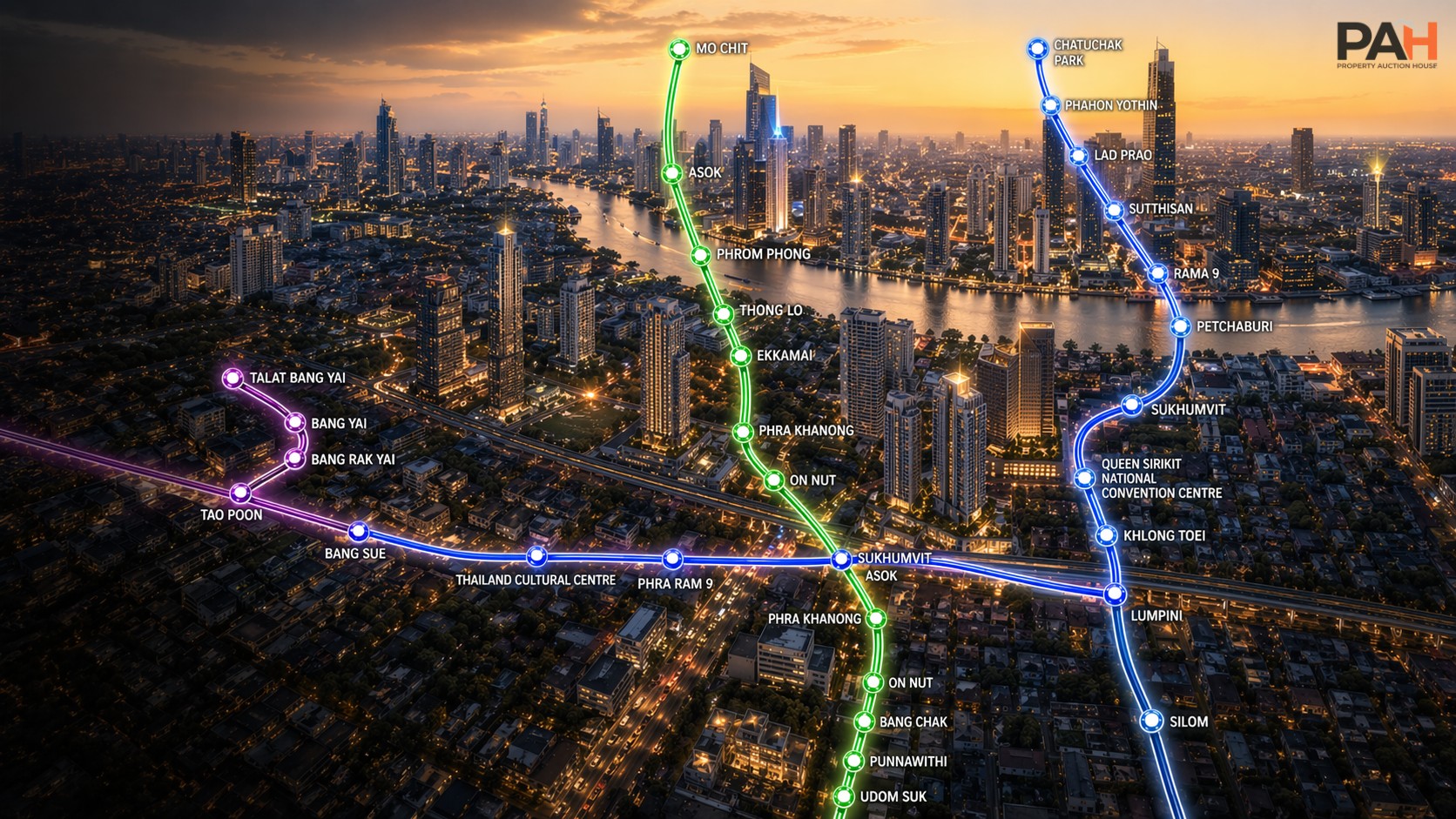
By 2026, Bangkok and its vicinity will have 10 operating mass transit lines, covering over 279 kilometers. Several other lines currently under construction are set to open between 2027–2030. The areas with the highest potential for price appreciation during this period are around interchange nodes and zones unlocked by the new Bangkok City Plan for high-rise development, particularly Min Buri, Ratchayothin, Don Mueang–Lak Si, Bangna–EEC Gateway, and Rat Burana.
Why Does Mass Transit Drive Property Prices?
Before diving into any location, it is crucial to understand that mass transit does not automatically drive land prices up everywhere; specific conditions must be met.
What is the Rail Effect?
The Rail Effect is the phenomenon where property prices within a 500-meter radius of a station increase by an average of 15–30% after the line becomes operational. More interestingly, prices often "adjust in advance" 2–3 years before the station actually opens—this is the golden window for investors.
3 Conditions for the Rail Effect to materialize:
The first condition is real demand—there must be a dense population, employment centers, and clear demand for housing beforehand. The second is a complete feeder system—stations must have transport connections like buses, motorcycle taxis, or shuttle services, otherwise, people won't use them. The third is a non-saturated supply—if many condos are launched before the station opens, prices may not rise because of leftover stock.
The Best Time to Invest:
Experienced real estate investors often agree that the pre-construction phase up to 2–3 years before a station opens is the "Sweet Spot" where purchase prices are low but the upside is clear. As the opening date nears, prices have often already been "priced in."
2026 Transit Map Update
10 Lines Currently in Operation
As of 2026, there are 10 main mass transit lines operating in Bangkok and its vicinity, including AP Thai coverage of inner Bangkok, suburban areas, and surrounding provinces.
BTS Light Green Line (Sukhumvit Line)
The Light Green Line was Thailand's first line, connecting three provinces: Bangkok, Pathum Thani, and Samut Prakan, with a total length of approximately 54.25 kilometers. It operates 47 stations, from Khu Khot to Kheha AP Thai.
BTS Silom Line covers 14 stations, running from National Stadium to Bang Wa, passing through key business districts like Siam, Sala Daeng, Silom, and Wongwian Yai.
MRT Blue Line operates 38 stations in a loop from Hua Lamphong to Tha Phra and Bang Sue, serving as the main backbone for the mass transit system in western and southern Bangkok.
Yellow and Pink Lines (Monorail) are in operation. The Yellow Line covers 23 stations from Lat Phrao to Samrong, while the Pink Line covers 30 stations from Khae Rai to Min Buri.
Currently, there are 9–10 operating lines, covering at least 280 kilometers, enhancing public mobility and effectively linking business districts, government centers, tourist spots, and local communities Nestopa.
Lines Under Construction and Pending Opening — Key Investor Points
MRT Orange Line (East) (Most Watch-Worthy)
The civil works for the Eastern Orange Line are 100% complete. It is the first phase to open, planned for late 2027 or early 2028. It consists of 17 stations (10 underground, 7 elevated) covering 22.57 km AP Thai.
MRT Orange Line (West)
The Western Orange Line is currently under construction, with an expected opening in late 2030. It will feature 11 stations covering 13.4 km AP Thai, passing through key areas like Bang Khun Non and Taling Chan.
Other planned transit lines:
Future lines and those in the master plan include the Brown Line, Silver Line, Grey Line, Blue Line (future expansion), and the High-Speed Rail connecting 3 airports Nestopa.
New Bangkok City Plan: The Game-Changer for Investment
Before analyzing any location, you must understand the "multiplier effect" that is about to occur.
The new Bangkok City Plan is set for public review for 90 days starting March 2026 and is expected to take effect by mid-2027 Thansettakij.
The most significant change for real estate investors is the expansion of orange zones (medium-density residential), facilitating the development of high-rise and large-scale buildings, especially around transit stations Thansettakij.
More importantly, within an 800-meter radius of interchange or transit hub nodes, developers can build ultra-large-scale and high-rise buildings exceeding 10,000 sqm or 23 meters in height (or with no height limit) Thansettakij.
The new city plan designates 9 high-potential "gold" zones along transit lines, such as Ratchayothin, Don Mueang–Lak Si, Min Buri, and Taling Chan, adjusting land usage to support urban expansion Thansettakij.
In investment terms: land values in these zones will rise immediately upon implementation because higher FAR (Floor Area Ratio) means developers are willing to pay more for the land.
Current Bangkok Land Prices: Know Before You Invest
Bangkok areas with significant land appraisal increases are primarily located in the city center and along transit lines Home.
Near the Asoke-Montri intersection and sections of Sukhumvit Road, appraisals have jumped from 200,000–210,000 THB to 600,000–750,000 THB per square wah. The most expensive new appraisals are on Silom, Ploenchit, and Rama 1 roads, reaching 1,000,000 THB per square wah Home.
Estimated Land Prices by Transit Zone
Area | Est. Price (THB/sq. wah) | Transit Status |
|---|---|---|
Silom–Ploenchit–Rama 1 | Up to 1,000,000 | Operational (BTS) |
Asoke–Sukhumvit | 600,000–750,000 | Operational (BTS+MRT) |
Lat Phrao–Ratchayothin | 200,000–400,000 | Operational (Interchange) |
Pradit Manutham | 200,000–500,000 | Pending Grey Line |
Don Mueang–Lak Si | 50,000–150,000 | Operational (Red+Pink) |
Bangna–Srinakarin | 80,000–250,000 | Operational + EEC |
Min Buri–East Ramkhamhaeng | 30,000–80,000 | Pending Orange (2027–2028) |
Rat Burana–Bang Pakok | 40,000–120,000 | Pending Southern Purple |
Taling Chan–Bang Khun Non | 60,000–180,000 | Red + Pending West Orange |
7 Gold Mine Locations for Investors in 2026
Location 1 — Min Buri–East Ramkhamhaeng: Pre-launch before the Orange Line
Why this area is most interesting right now:
The Eastern Orange Line's civil work is 100% complete, but land prices in the Min Buri area have yet to fully reflect this reality. That is the gap investors can exploit.
Investment-worthy locations in 2026 rely on new infrastructure like transit and highways, existing large employment hubs, and comprehensive amenities Thansettakij.
Min Buri has the densest population in Eastern Bangkok but has long lacked primary mass transit. The arrival of the Orange Line represents the biggest infrastructure change this area has ever experienced.
Things to know before investing:
Within a 500-meter radius of the Min Buri terminal and central stations, there is still land available.
Real demand is high because it is an established, densely populated residential area, not a new development site.
Mid-range condos (1.5–3 million THB) are the most in-demand product here.
Est. Land Price: 30,000–80,000 THB/sq. wah. Ideal for: 3–5 year medium-term investors, rental property buyers.
Location 2 — Ratchayothin: Interchange Node Unlocked by New City Plan
Strength: Being a key transit intersection.
Ratchayothin is the link between the Green Line (BTS) and the Blue Line (MRT), and will be close to the Brown Line (Phase 2 Master Plan).
The new Bangkok City Plan clearly designates Ratchayothin as one of the 9 "gold" zones. Thanks to the interchange rule allowing for unlimited high-rise height within 800 meters, land here has an FAR that developers are willing to pay a premium for.
Supporting factors:
Surrounded by multiple Mixed-Use projects and large Community Malls.
Working professionals in the Phaholyothin–Ari zone prefer living near their workplace.
Rental yields remain attractive for upper-tier condos.
Est. Land Price: 200,000–400,000 THB/sq. wah. Ideal for: Long-term investors, owner-occupiers expecting capital gains.
Location 3 — Don Mueang–Lak Si: Gold zone with low entry prices
Designated as a high-potential development zone under the new city plan.
The new city plan places Don Mueang–Lak Si as a high-potential zone Thansettakij. Combined with the Lak Si interchange (Pink and Red lines), the area has stacked positive factors.
The advantage is that land prices remain lower than surrounding areas, despite the proximity to Don Mueang Airport, which attracts demand from aviation workers, business travelers, and foreigners residing in Northern Bangkok.
Special point: The area within a 500–800 meter radius of Lak Si station still has empty plots and old buildings ripe for redevelopment at reasonable prices.
Est. Land Price: 50,000–150,000 THB/sq. wah. Ideal for: Medium–long term investors, mid-tier condos, Boutique hotels.
Location 4 — Bangna–Krungthep Kreetha–Srinakarin: EEC Gateway with remaining opportunities
Identified by experts as the "hottest boom area in the East."
Srinakarin, Phatthanakan, On Nut, and Krungthep Kreetha are seeing a boom thanks to the new Krungthep Kreetha road connecting Rama 9, Ramkhamhaeng, and Srinakarin. It is ideal for landed residential projects in the 8–20 million THB range. It features dense infrastructure with the BTS Sukhumvit line, Airport Rail Link, expressways, and motorways, and is near Suvarnabhumi Airport, perfect for aviation professionals Thansettakij.
Additionally, the high-speed rail connecting 3 airports (Don Mueang–Suvarnabhumi–U-Tapao) will turn the Bangna–Trat zone into a key EEC gateway, attracting international investors, expats, and logistics businesses.
Market gap: 8–20 million THB detached houses sell well with no supply glut. Condos near the Airport Rail Link also enjoy high rental yields from frequent travelers.
Est. Land Price: 80,000–250,000 THB/sq. wah. Ideal for: All investment types: owner-occupied, rental, and long-term capital gains.
Location 5 — Rat Burana–Bang Pakok: Undervalued, awaiting the Southern Purple Line
The most "overlooked" location in Bangkok right now.
Rat Burana is a dense residential area with a large population but no transit coverage. The upcoming Southern Purple Line (Tao Poon–Rat Burana) will be a historic infrastructure change for this district.
The attractiveness lies in land prices being very low despite being only 10–15 kilometers from the city center, and there is high real demand from mid-level workers seeking affordable, accessible housing.
Wait time: The Southern Purple Line is still under construction and expected to take 5–7 years to open, so this is a long-term investment, not short-term.
Est. Land Price: 40,000–120,000 THB/sq. wah. Ideal for: 5–10 year long-term investors, monthly rental cash flow.
Location 6 — Taling Chan–Bang Khun Non: Western Bangkok waking up
One of the 9 gold locations in the new Bangkok City Plan.
The new city plan lists Taling Chan as a high-potential zone Thansettakij, consistent with the already operating Light Red Line at Taling Chan and the Western Orange Line currently being built through Bang Khun Non.
Western Bangkok is often seen as "the other side," but it actually holds dense communities, improving connectivity, and much lower land prices than the East.
Special point: The area around Bang Khun Non station on the Western Orange Line is the clearest "pre-launch" opportunity in Western Bangkok right now.
Est. Land Price: 60,000–180,000 THB/sq. wah. Ideal for: Medium-term investors, detached houses, Mixed-Use projects.
Location 7 — Pradit Manutham: The affluent road awaiting the Grey Line
A location experts call a "land-based treasure trove."
Land prices in Pradit Manutham are trending toward 500,000–600,000 THB/sq. wah from the current 200,000–300,000 THB. At key intersections like Lat Phrao or Rama 9, prices are set to reach 1 million THB/sq. wah Thansettakij.
The future Grey Line will drive prices further, supported by the new city plan re-zoning this area from yellow to orange, allowing condo developments Thansettakij.
This area already hosts premium residences and office buildings, signaling that "smart money" has already entered the location.
Est. Land Price: 200,000–500,000 THB/sq. wah. Ideal for: High-end investors, luxury houses, High-End condos, office buildings.
7-Location Side-by-Side Comparison
Location | Short-term Spec | Rental Yield | Long-term Capital Gain | Entry Price | Risk |
|---|---|---|---|---|---|
Min Buri (East Orange) | ⭐⭐⭐⭐ | ⭐⭐⭐⭐ | ⭐⭐⭐⭐⭐ | Low | Medium |
Ratchayothin | ⭐⭐ | ⭐⭐⭐⭐ | ⭐⭐⭐⭐ | High | Low |
Don Mueang–Lak Si | ⭐⭐⭐ | ⭐⭐⭐⭐ | ⭐⭐⭐⭐ | Medium | Low |
Bangna–EEC | ⭐⭐⭐ | ⭐⭐⭐⭐⭐ | ⭐⭐⭐⭐⭐ | Medium | Low |
Rat Burana | ⭐⭐⭐⭐⭐ | ⭐⭐⭐ | ⭐⭐⭐⭐⭐ | Low | High (Wait) |
Taling Chan–Bang Khun Non | ⭐⭐⭐ | ⭐⭐⭐ | ⭐⭐⭐⭐ | Medium | Medium |
Pradit Manutham | ⭐⭐ | ⭐⭐⭐ | ⭐⭐⭐⭐⭐ | Very High | Low |
Warning: Transit Locations aren't always good
The most dangerous misconception in real estate is: "There is a train line = prices always go up." The reality is more complex.
Oversupply Risk is a common trap. Areas with many condo launches before the train starts—especially in the mass-market segment—often don't see price appreciation due to high leftover stock.
Last Mile Problem can kill demand. Stations located in the middle of nowhere without feeder systems will be avoided by residents.
Delays: Almost every line in Bangkok has faced delays. Investors must prepare for a wait of 1–3 years beyond the original plan.
Caution: Avoid condos more than 1 kilometer from a station in areas without dense existing communities, as the Rail Effect diminishes rapidly with distance.
Bangkok Real Estate Outlook 2026
The market is expected to recover slowly, buoyed by domestic and international factors Realplusgroup.
On the positive side, tourism growth boosts international purchasing power for investment and secondary homes, and the influx of expatriates increases housing demand Realplusgroup.
However, challenges include rising financial costs due to domestic interest rates and high household debt, making consumers cautious about long-term debt Realplusgroup.
Investors should look for locations with new infrastructure, employment hubs, and "small city" amenities (malls, schools, hospitals) with accessible pricing compared to the city center Thansettakij.
FAQ
Q: How long before a line opens should I buy? Pre-construction to 2–3 years before opening is the Sweet Spot, provided construction progress is verified. Closer to the date, the price is already "priced in."
Q: Will the Orange Line actually open by 2027? Civil works are 100% complete, but system installation takes time. Late 2027 to early 2028 is highly possible, though 6–12 months delay is possible.
Q: Condo price difference between 500m vs 1km? Significant. Studies show properties within 500m are 15–25% higher in price than those within 1km, with higher rental demand.
Q: How will the new City Plan affect prices? Expected in 2027, it will unlock high-rise zoning within 800m of interchange stations, causing immediate price jumps due to higher allowed FAR.
Q: Why is Bangna–Trat still worth it? Because the EEC is still in its early stages, the high-speed rail isn't finished, and demand from expats/logistics keeps growing.
Q: Beginner with 2–3 million THB, where to start? Min Buri or the Orange Line area is the best starting point—low entry, high demand, clear upside.
Summary — Match your target
Real estate investment around transit isn't a silver bullet; it's a game of variables: transit, city planning, EEC, and actual demand.
For 5–10 year Capital Gain → Min Buri, Rat Burana, and Pradit Manutham offer the highest upside.
For Rental Cash Flow → Bangna–EEC Gateway and Don Mueang–Lak Si have strong, continuous rental demand.
For Balance → Ratchayothin and Taling Chan offer the best Risk-Reward.
Golden Rule: Don't just buy "the train line." Buy "Real Demand + Train Line + Supportive City Plan." These three must point in the same direction.
Updated: April 2026 | Reference: Current status of transit projects and Bangkok market trends | This article is for educational analysis, not financial advice.