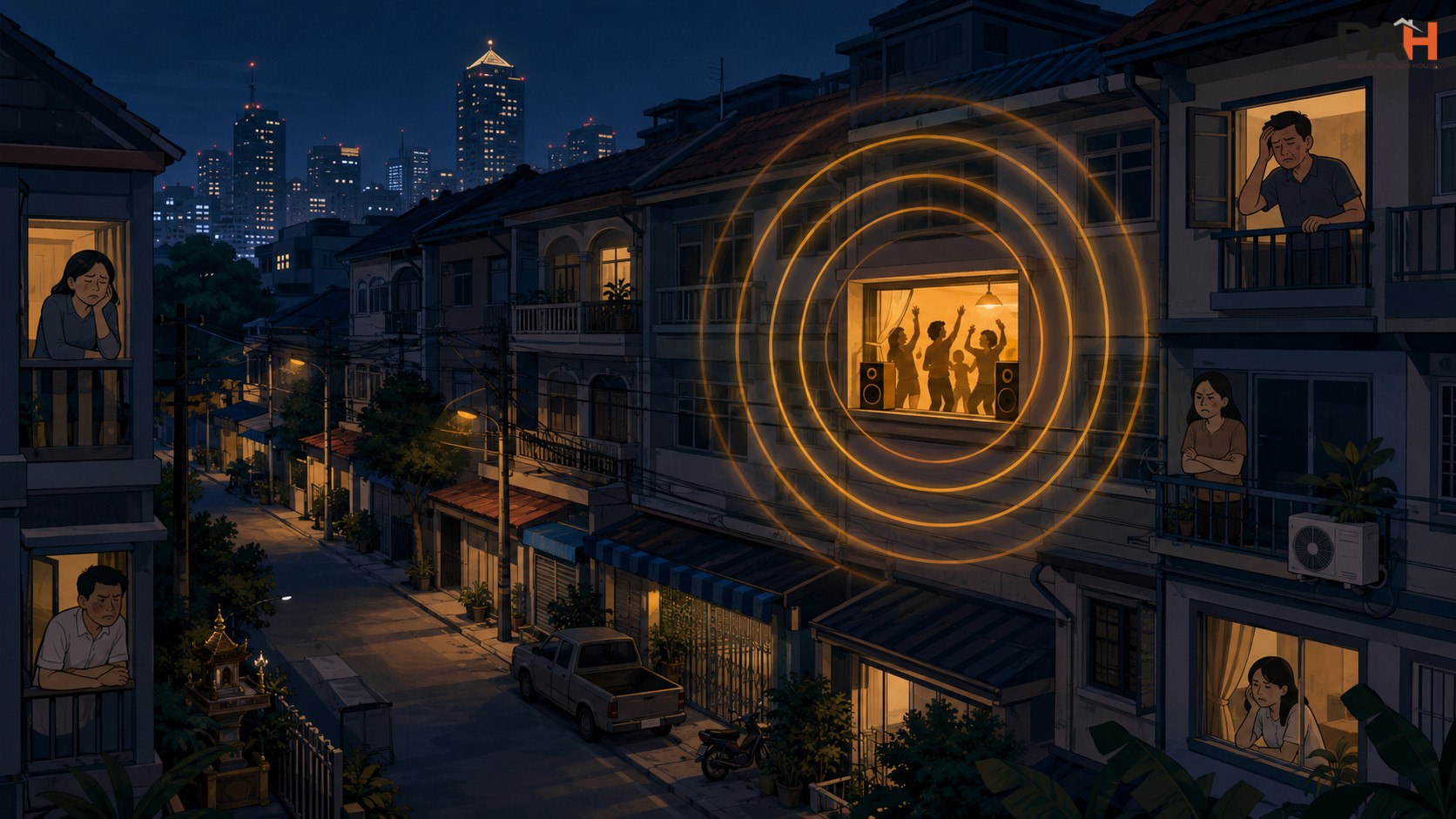
It's past 3 AM, and your neighbor is still singing karaoke, speakers blasting at full volume, even though you have to wake up early for work. What can you actually do?
The answer is — more than you might think. Thailand has laws specifically protecting against this, and there are effective reporting channels available both day and night. This article covers everything you need to know, from the relevant laws and quiet hours to how to collect evidence and the hotlines you can call immediately.
Laws Regarding Noise Pollution
Noise disturbances are not just a nuisance; there are several laws that directly support the rights of those affected.
The Enhancement and Conservation of National Environmental Quality Act, B.E. 2535 (1992) is the primary law that empowers the Pollution Control Department to set environmental noise standards and authorizes local authorities to enforce them. If noise levels exceed the standard, the owner of the premises is liable and may be fined or ordered to cease the activity immediately.
Section 397 of the Criminal Code states that anyone who commits an act of harassment, intimidation, or causes another person to suffer shame or public annoyance shall be subject to a fine of up to 5,000 baht. This includes causing loud noises at night. Even without malicious intent, if the act causes distress to others, it is considered an offense.
The Public Health Act, B.E. 2535 (1992) (often applied alongside local regulations) empowers local government organizations such as the BMA (Bangkok Metropolitan Administration), municipalities, and sub-district administrative organizations (SAO) to issue local ordinances defining prohibited times and noise levels. Generally, these regulations set quiet hours from 10:00 PM to 6:00 AM the following day.
At what time is loud noise considered illegal?
While there is no fixed nationwide time, the standards generally applied by Thai agencies and courts are as follows:
During the day (06:00–22:00), noise levels in residential areas should not exceed 70 decibels (dB-A). At night (22:00–06:00), levels should not exceed 50–55 decibels (dB-A), or should not exceed the background noise level of that environment by more than 10 decibels.
To put this in perspective, 50 decibels is equivalent to the volume of a normal conversation in a room, while karaoke or large speakers easily exceed 80–100 decibels.
Simply put, after 10:00 PM is legally considered "rest time." Causing noise loud enough to disturb others is a clear violation, whether it is music, a party, construction work, or machinery.
Reporting Channels
When you encounter a noise disturbance, there are several ways to file a complaint:
Call Hotline 1337: This is the Pollution Control Department’s 24-hour hotline. It is ideal for cases where you need officials to officially measure noise levels or wish to file a formal complaint for legal proceedings.
Call Hotline 1555: For residents of Bangkok, this line connects directly to the BMA Call Center, which can dispatch district officials to investigate.
Call 191: Or contact your local police station. This is for urgent situations where you need officers to arrive at the scene as soon as possible, especially if you have already warned the offender and they refuse to stop.
Call 1300: The hotline for the Department of Local Administration, for areas outside of Bangkok, such as municipalities or SAOs in other provinces.
Report Online: Via the "Traffy Fondue" application, which the BMA uses as its primary complaint system. You can attach photos or video clips directly. Additionally, you can file a report through the website pcd.go.th of the Pollution Control Department, or contact your local district office/municipality directly.
Recommended Steps When Dealing with Noise
Handling noise disturbances should follow a logical sequence to ensure the strongest legal standing.
First, always politely warn the offender directly. Sometimes, the person making the noise may not realize how loud they are. A direct conversation is often the fastest way to solve the problem while maintaining community relationships.
If you have warned them and they do not stop, call 191 or your local hotline to have authorities handle it immediately.
In the meantime, start gathering evidence, including video clips and audio files with clear dates and times.
If the problem remains unresolved, file a formal complaint with your district office, municipality, or the Pollution Control Department, attaching all the evidence you have collected.
Finally, if the problem is recurring and remains unaddressed by the authorities, you may consider filing a civil lawsuit to claim damages.
Penalties You Should Know
The penalties depend on the specific law applied to the case.
For general personal disputes, such as a noisy neighbor, Section 397 of the Criminal Code is typically used, carrying a fine of up to 5,000 baht.
For commercial establishments such as restaurants, bars, karaoke venues, or factories, the Environmental Act applies. This carries much heavier penalties: a fine of up to 200,000 baht, imprisonment of up to 1 year, or both. The business may also be ordered to close temporarily.
Tips for Collecting Strong Evidence
Good evidence is key to a successful complaint.
Use a sound level meter application such as "Decibel X" or "NIOSH SLM" on your smartphone. These apps show real-time decibel values and can record peak levels. Take a screen recording of the app alongside a video of the atmosphere to provide context, and keep a log of every incident, including the date, time, and duration, to demonstrate that it is an ongoing issue, not a one-time event.
The best evidence is information with a timestamp, measured decibel values, and context regarding the location and time of the occurrence.
Conclusion
Nighttime noise disturbance is not a minor issue that you have to suffer in silence. Thai law has provisions to protect the rights of those affected, from defined quiet hours and noise limits to clear penalties.
Know your rights, collect your evidence, and report through the proper channels. You don't have to suffer alone.