How to Choose the Right Flooring: Durable, Functional, and Cost-Effective
Comparing 6 popular flooring materials with a guide to choosing based on space, budget, and lifestyle
Introduction: Why Flooring Choice Matters More Than You Think
Your floor is the surface you touch every single day, from the moment you step out of bed in the morning until you go to sleep at night. Yet, in reality, many people choose flooring based on a single factor, such as "low price" or "looks good in photos," without considering usage habits, weather conditions, or long-term maintenance costs.
The consequences can be floors that swell when exposed to water, scratch marks after only a few years of use, or repair costs that exceed the initial material investment.
This article is written as a comprehensive decision-making guide, ranging from understanding key factors to a straightforward comparison of each flooring type.
Key Factors to Consider Before Choosing Flooring
Before deciding which material is best, always answer these 5 questions:
1. What is the usage area? Bedrooms need warmth and comfort underfoot. Bathrooms need 100% waterproof materials. Kitchens need to be easy to clean. Balconies need to withstand sun and rain. The requirements for each room are completely different.
2. Who lives in the house? If there are young children or the elderly, the floor must be slip-resistant and shock-absorbent. If you have pets, it must be resistant to claw marks, urine stains, and odors.
3. What are your short-term and long-term budgets? Cheap materials may need to be replaced in 5 years, while high-quality materials can last 30 years with minimal care. Calculating the cost per year is more important than the initial price.
4. How are the climate and humidity levels in your area? Thailand is highly humid year-round. Materials that absorb water will swell, warp, or grow mold. Moisture-resistant materials are indispensable.
5. What is your preferred decor style and accepted level of maintenance? Some are willing to pay more to avoid maintenance, while others don't mind extra upkeep for the sake of aesthetics. There is no wrong answer, but you must know yourself first.
6 Popular Flooring Materials: Honest Pros and Cons
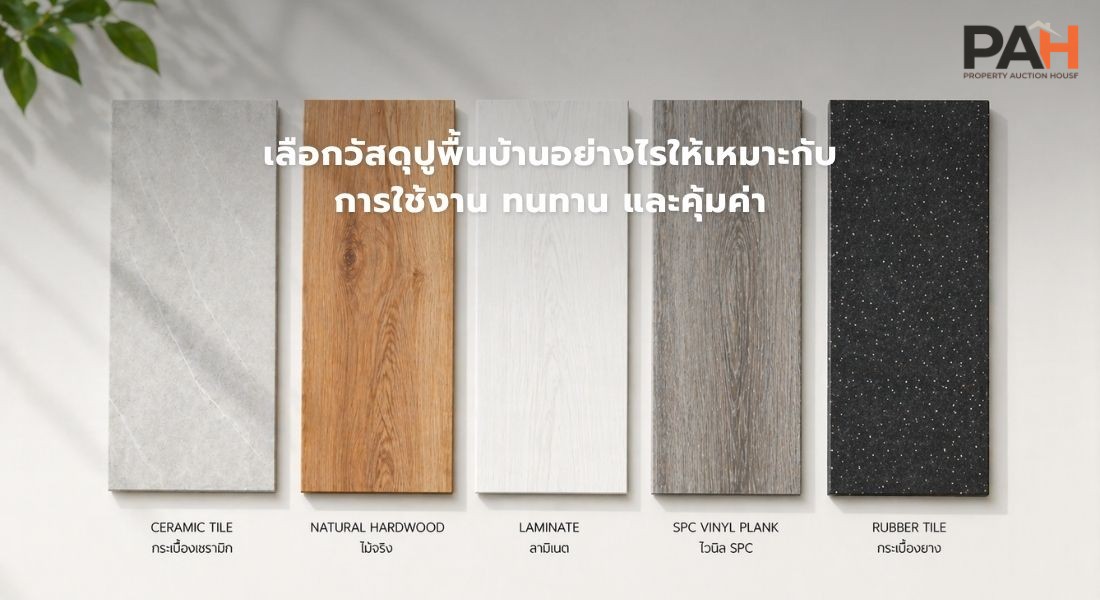
1. Ceramic and Porcelain Tiles
Tiles are the most popular choice for Thai homes due to their excellent moisture resistance, ease of cleaning, and a wide price range from budget to luxury.
The highlight is their extreme durability; they can last 30–50 years, are 100% waterproof, do not accumulate mold, and are easy to maintain. Porcelain has a higher density than ceramic, making it more resistant to scratches and heavy traffic.
The limitations to watch out for are that tiles are hard and cold; a fall will hurt more than on other materials. Additionally, cracks from structural settlement are difficult to fix, and installation requires skilled workers to prevent issues like tile lifting or loose grout.
Suitable for: Bathrooms, kitchens, living rooms, hallways, and balconies.
2. Solid Wood & Engineered Wood
Wood flooring provides warmth and beauty that synthetic materials struggle to replicate. It is a premium choice that remains highly sought after in the high-end real estate market.
Solid wood offers an authentic feel and can be refinished multiple times. Engineered wood consists of several layers of real wood compressed together, providing better stability, less warping, and better moisture resistance than solid wood.
Key limitations are the high price and the need for regular maintenance (applying sealant every 1–3 years). In the humid climate of Thailand, special care is required; it is not suitable for bathrooms or areas frequently exposed to water.
Suitable for: Bedrooms, living rooms, home offices.
3. Laminate Flooring
Laminate is a synthetic material designed to imitate wood flooring at a more accessible price. It consists of an HDF core, a decorative layer, and a protective surface layer.
Highlights include a budget-friendly price, easy installation via click-lock systems (no glue required), a wide variety of patterns, and easy daily maintenance.
Limitations to be aware of: Laminate is not completely waterproof, especially at the joints. If water seeps into the HDF core, it will swell and ruin the floor. It cannot be refinished like real wood; once damaged, the plank must be replaced. It can also be noisy to walk on if there is no proper underlayment.
Suitable for: Bedrooms, living rooms not prone to water, condominiums.
4. SPC (Stone Plastic Composite) Flooring
SPC is an innovative flooring material that has become the most popular choice in the last 3–5 years. It is made from limestone mixed with PVC, resulting in a strong, completely waterproof, and much more stable material than laminate.
The main reason for SPC's rise in popularity is that it is 100% waterproof (even with water standing overnight), resistant to expansion due to temperature and humidity, lighter than tile, easy to install via click-lock, and usually includes a built-in underlayment that reduces noise well.
The main limitation is that it is more expensive than laminate, and if exposed to direct sunlight for long periods, the color may degrade faster than other materials.
Suitable for: Every area of the house, including bathrooms, kitchens, and high-humidity areas. It is the best "all-rounder" for homes in Thailand.
5. Synthetic Rubber and Vinyl
This category includes Vinyl Plank, Vinyl Tile, and Rubber Flooring, which are particularly suitable for specific areas.
Rubber flooring is soft and highly slip-resistant, making it suitable for home gyms, playrooms, or areas requiring extra safety. It is affordable and easy to install. LVP (Luxury Vinyl Plank) provides a realistic wood look at an affordable price.
The limitation is its lower resistance to sharp objects and high heat, with a shorter lifespan than other materials at the same price point.
Suitable for: Home gyms, children's rooms, areas requiring extra slip resistance.
6. Carpet
Carpet is a choice that provides warmth, sound insulation, and an ambiance that no other material can match. However, in Thailand's climate, it has more limitations compared to colder countries.
Highlights include excellent slip resistance, the best sound absorption among all materials, warm comfort underfoot, and low installation costs.
However, in the high humidity of Thailand, carpets easily collect dust, dust mites, and mold. They require special cleaning and care. If they get wet, they are difficult to dry. They are not suitable for people with dust allergies or respiratory conditions.
Suitable for: Bedrooms, private home theaters, provided there is a good humidity control system.
Summary of Flooring Selection by Usage Area
Area | Recommended | Avoid |
|---|---|---|
Bedroom | SPC, Laminate, Solid Wood | Tiles (cold and hard) |
Bathroom | Porcelain Tile, SPC | Solid Wood, Laminate |
Kitchen | Tile, SPC | Carpet, Laminate |
Living Room | Tile, SPC, Solid Wood | Carpet (difficult to clean) |
Balcony/Outdoor | Anti-slip Tile | Solid Wood, Laminate, SPC |
Children's Room | SPC, Rubber, Carpet | Tile (hard if fallen) |
Checklist Before Buying Flooring
Before placing an order, try checking the following list:
✅ Identify which areas have high traffic and humidity.
✅ Set a budget per square meter (including installation costs).
✅ Check the material thickness against door frames and stairs.
✅ Request a sample to test in your home's natural light before deciding.
✅ Ask the seller about the warranty period and claim conditions.
✅ Calculate the actual area and add 10% for cutting and waste.
✅ Check if the original floor needs leveling before installation.
Conclusion
There is no single formula for choosing the right flooring, but there is a simple principle: choose based on the area and usage behavior, not just aesthetics alone.
For a quick recommendation for homes in Thailand, SPC is the "safest" choice for those who want durability, waterproof features, and easy maintenance at a reasonable price. Porcelain tile remains the king of durability for bathrooms and kitchens, while solid wood remains a symbol of luxury that is hard to replace.
Investing in good flooring from the beginning is a way to save money and time in the long run.