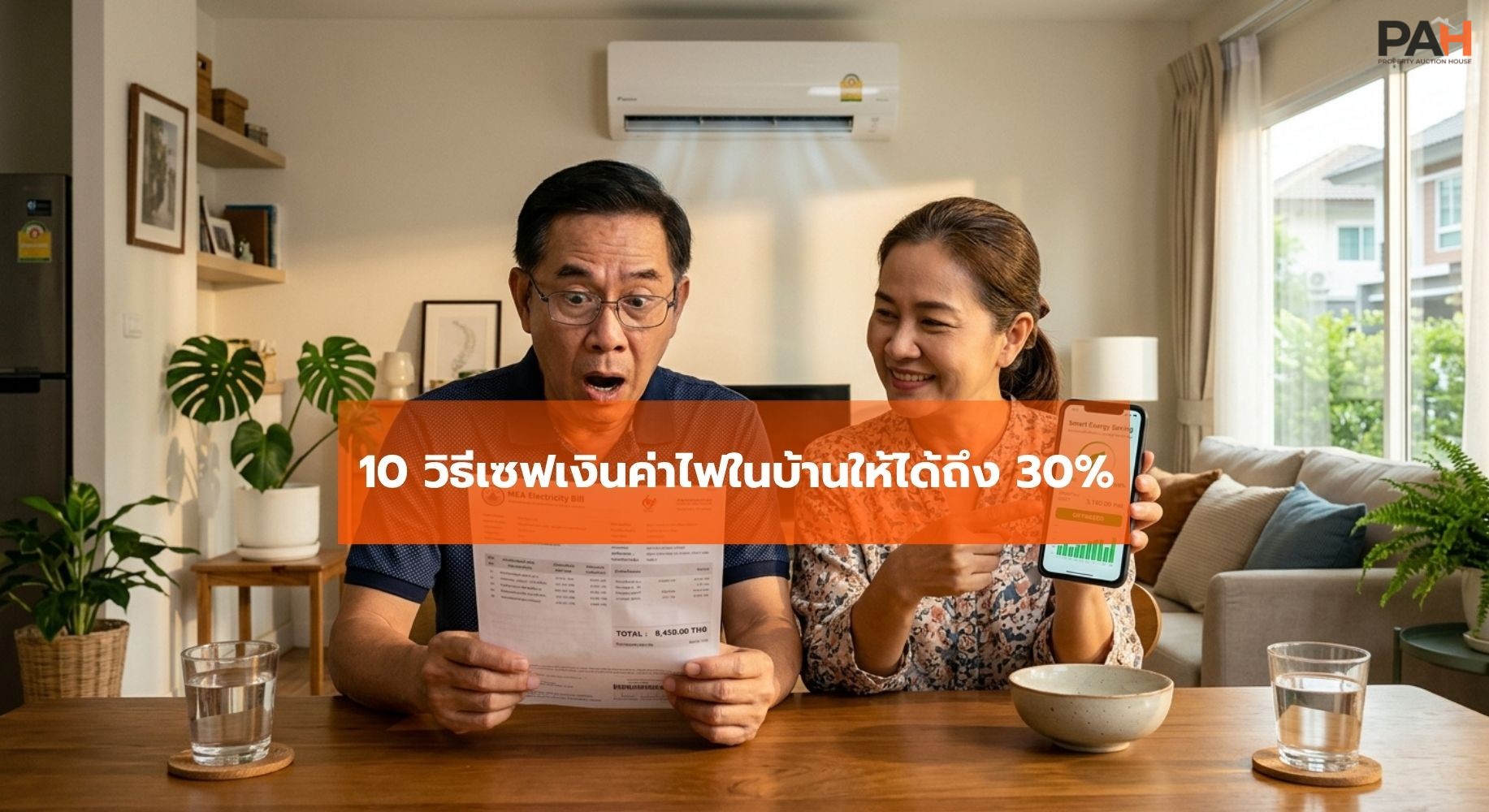
Shocked by your electricity bill? 10 ways to save up to 30% on home energy costs — start tonight
A complete guide for Thais who want to pay less for electricity without having to endure the heat or make huge investments.
The average electricity bill for Thai households has been rising every year. But did you know that small, daily habits — from turning on the air conditioner to charging your phone — are silently consuming power? This article compiles 10 proven methods to effectively reduce your electricity bill by up to 30%, complete with figures and real-world examples.
Introduction — Why does the electricity bill get higher every year?
Picture this: You open your electricity bill this month and jump. The total has increased by nearly 500 baht from the previous month, even though you didn't buy any new appliances and haven't spent more time at home. So, where did the money go?
The average electricity bill for a Thai household is approximately 1,500–3,500 baht per month, depending on the size of the house and usage habits. Over the past few years, the Ft (Fuel Tariff) has consistently risen in line with global fuel prices, making many households feel like they are paying the same but getting less.
The most surprising thing is that over 70% of unnecessary electricity costs can be solved without spending a single baht; you just need to know the culprits and change a few small habits.
This article will guide you through 10 methods, ranging from the easiest (doable today, for free) to worthwhile long-term investments. Each method includes clear estimated figures to help you decide where to start.
Know the culprits first: Which appliances consume the most electricity?
Before you can save, you need to know who the biggest consumers are. Here is a table that will change your perspective forever.
Appliance | Power (W) | Daily Usage | Electricity cost/month (est.) |
|---|---|---|---|
12,000 BTU Air Conditioner (non-inverter) | 1,200 W | 8 hours | ~520 Baht |
Water Heater | 3,500 W | 20 mins x 3 times | ~450 Baht |
2-door Refrigerator | 150 W | 24 hours | ~65 Baht |
Washing Machine (with dryer) | 2,000 W | 1 hour/day | ~180 Baht |
60W Incandescent Bulb (x10) | 600 W | 6 hours | ~130 Baht |
55-inch TV + set-top box | 150 W | 5 hours | ~35 Baht |
Standby mode (entire house) | ~100 W | 24 hours | ~170 Baht |
Notice that air conditioners and water heaters are the real suspects, accounting for nearly 1,000 baht of the total bill, and "switched off" standby devices still consume nearly 170 baht per month for absolutely no benefit.
Now, we are ready to dive into the 10 methods.
Methods 1–3: Adjusting habits, zero investment required
Starting with the easiest and most effective methods, these 3 can be done today without spending a single baht.
Method 1 — Set AC to 25–26°C instead of 22°C
This is something everyone knows, but few do.
For every 1°C increase in setting, the AC consumes 6–8% less electricity. This means if you set your AC to 26°C instead of 22°C, you avoid paying 25–30% more on your electricity bill unnecessarily.
Try this:
Set the AC to 26°C and turn on an extra fan.
A fan consumes only 30–60W but provides a cooling sensation equivalent to lowering the AC by 2–3°C.
Save about 100–150 baht per month on just one AC unit.
Additionally, don't forget to clean the AC filter every 2 weeks. Clogged filters make the AC work 10–15% harder. It only takes 10 minutes, but provides savings all year round.
Estimated savings: 100–180 baht/month
Method 2 — Unplug everything not in use
Standby mode, often called the "electric ghost," is one of the most overlooked energy costs.
Check this list to see how many you have in your house:
TVs turned off by remote (not unplugged) consume 5–15W.
Set-top boxes consume 10–20W 24 hours a day.
Microwaves with clock displays consume 3–5W.
Phone chargers left plugged in consume 0.5–1W each.
Computers that are "off" but still plugged in consume 5–15W.
If you have 10 such items consuming an average of 10W each, 24 hours a day, 30 days a month = 72 units ≈ 250–300 baht per year spent for nothing.
The easiest solution: Use a power strip with a switch, grouping devices (living room group, bedroom group). Press one switch before bed to cut power to all of them at once.
Estimated savings: 100–200 baht/month
Method 3 — Quit using the dryer, use the sun instead
Thais are lucky to have sunlight all year round, yet many spend money on dryers to compete with the sun.
Standard dryers consume 2,000–4,000W per cycle (about 1–1.5 hours). If used daily, the cost is 250–450 baht per month just to dry clothes.
Even if you don't use it every day, just using it 3–4 times a week can save you 150–250 baht per month if you switch to sun drying.
An extra tip: Wash clothes with cold water instead of warm water, as the water heating system in a washing machine is the biggest energy drain. Modern detergents are designed to work perfectly with cold water anyway.
Estimated savings: 150–300 baht/month (if dryer use is reduced)
Methods 4–6: Small upgrades, big results
These 3 methods require a small investment, but they pay for themselves within 6–12 months and provide ongoing savings for many years.
Method 4 — Replace all incandescent and fluorescent bulbs with LED
This is the most worthwhile investment among all the methods in this article.
A clear comparison:
Bulb type | Power | Brightness | Lifespan | Electricity cost/year (6 hrs/day) |
|---|---|---|---|---|
Incandescent | 60W | 800 lumens | 1,000 hours | ~79 Baht |
Fluorescent | 15W | 800 lumens | 8,000 hours | ~20 Baht |
LED | 8W | 800 lumens | 25,000 hours | ~11 Baht |
If your home has 10 60W incandescent bulbs, your lighting cost is about 790 baht per year. Replacing them all with 8W LEDs reduces the cost to only 110 baht per year. Save 680 baht per year by investing 40–80 baht per LED bulb; it pays for itself within 6 months.
Estimated savings: 100–200 baht/month | Payback in 3–6 months
Method 5 — Install roof or ceiling insulation
Most people don't know that over 40–60% of heat in a Thai home comes directly from the roof, especially houses using corrugated or metal sheet roofing that absorbs solar heat and radiates it into the house all day long.
When the house is hot, the AC must work harder to pull the temperature down, which means AC electricity bills spike accordingly.
Popular insulation options:
Fiberglass: Cheap ~50–80 baht/m², easy to install, reduces heat well long-term.
Spray Foam: More expensive but also waterproof ~150–300 baht/m².
Radiant Barrier: Mid-range ~80–150 baht/m², reflects infrared radiation very well.
For a 150 m², two-story house, investing 8,000–15,000 baht in insulation can reduce indoor temperature by 3–5°C, making the AC work 15–20% less, paying for itself within 1.5–2.5 years.
Estimated savings: 80–150 baht/month | Payback in 1–2 years
Method 6 — Heat-blocking curtains and UV-blocking film
Unprotected home windows are like "doors left open for heat." Sunlight passes through the glass and traps heat inside, known as the Greenhouse Effect.
UV-blocking film: Priced around 500–1,500 baht per square meter (including installation), it can filter 30–70% of heat depending on the grade, with a lifespan of 10–15 years.
Blackout curtains: Besides blocking 90% of sunlight, they also help make the bedroom darker and make sleeping easier.
Homes with fully installed film and curtains on all windows can reduce the AC load by 10–20%, which converts to savings of approximately 80–200 baht per month.
Estimated savings: 80–200 baht/month | Payback in 1–2 years
Methods 7–9: Technology to the rescue
Nowadays, affordable technology helps you save electricity without changing your habits at all.
Method 7 — Smart Plug and automatic timers
Have you ever fallen asleep with the AC still running? A classic problem many households face.
Smart plugs with timers start at just 300–500 baht each. Set them to automatically turn off the AC after you've been asleep for 2 hours, or set schedules like turning off at 2:00 AM and back on at 5:30 AM.
Savings from not running the AC all night (assuming 4 hours of reduction) amount to approximately 60–80 baht per night, or 1,800–2,400 baht per month for households that run bedroom AC every night.
Besides ACs, they can be used for water heaters (set to warm up 15 minutes before waking), water pumps (off after midnight), and fish tanks (set lighting to natural patterns).
Estimated savings: 200–500 baht/month | Payback within 1 month
Method 8 — Choose an Inverter system when it's time to replace your AC
If your home AC is over 8–10 years old and is still a conventional system (non-inverter), this is the most worthwhile long-term investment.
Key difference between Inverter and Non-Inverter:
Conventional ACs work on a "full power or off" basis; the compressor starts and stops repeatedly every time the temperature rises above the set point. Each compressor start consumes a high amount of energy, like a car accelerating fully and then braking repeatedly.
Inverter ACs adjust the compressor speed continuously. When the temperature is near the target, it slows down rather than restarting, much like a car driving at a constant speed on a highway.
Result: Inverter ACs are 30–50% more energy-efficient than conventional ones in real-world use.
For a home running the AC 8 hours a day, a non-inverter unit costs about 520 baht/month. Switching to an inverter model of the same capacity reduces the cost to only 280–360 baht/month, saving 160–240 baht per month or nearly 2,000 baht per year.
A 12,000 BTU Inverter AC costs about 15,000–22,000 baht; it pays for itself through electricity savings within 6–9 years, which is less than the typical 10–15 year lifespan of an AC.
Estimated savings: 150–250 baht/month | Payback in 5–8 years
Method 9 — Use apps to track electricity usage
What gets measured gets managed, and now there are free tools that allow you to visualize your electricity usage in detail.
Recommended apps for Thais:
MEA Smart Life (for MEA areas — Bangkok and vicinity): View bills, track daily usage, set alerts when usage exceeds targets.
PEA Smart Plus (for PEA areas — provincial): Similar features, including outage notifications.
Smart meter or Energy Monitor: A device attached to the fuse box, priced 1,500–3,000 baht, showing real-time usage via an app to identify hours where usage is abnormally high.
Having data helps you realize, for instance, that an old water heater is consuming more power than normal (perhaps due to a failing heating element), catch a malfunctioning refrigerator, or notice that your power usage on weekends is twice as high as weekdays.
Estimated savings: 50–150 baht/month (from identifying habits and faulty equipment)
Method 10: Solar Rooftop — One-time investment, 25 years of returns
This is the "biggest" method, but it also provides the best returns.
What is a Solar Rooftop and who is it for?
A Solar Rooftop system involves installing solar panels on your house roof to generate electricity for your own use during the day, reducing dependence on the grid. Any surplus power produced can be sold back to the power authority.
Suitable for:
Homes with roofs not shaded during the day (9:00 AM–3:00 PM).
Usage of 500 units or more per month.
Planning to stay in the home for longer than 10 years.
Numbers to know
For a 3 kWp system (suitable for medium-to-large houses):
Item | Approximate Cost |
|---|---|
System installation cost | 90,000–120,000 Baht |
Electricity produced/month | 350–400 units |
Electricity savings/month | 1,200–1,600 Baht |
Electricity savings/year | 14,400–19,200 Baht |
Payback period | 6–8 years |
Panel lifespan | 25–30 years |
Lifetime net returns | 260,000–480,000 Baht |
Tax benefits in Thailand
Currently, investing in Solar Rooftops in Thailand allows you to deduct expenses from personal income tax under renewable energy promotion projects. You should check the latest conditions with the Revenue Department or a tax consultant before deciding.
Estimated savings: 1,200–1,600 baht/month | Payback in 6–8 years
Summary: How much can you save if you follow all 10 methods?
Method | Est. savings/month | Cost |
|---|---|---|
1. Set AC 26°C + extra fan | 100–180 Baht | Free |
2. Unplug standby devices | 100–200 Baht | Free |
3. Air dry instead of dryer | 150–300 Baht | Free |
4. Replace with LED bulbs | 100–200 Baht | 500–1,500 Baht |
5. Roof insulation | 80–150 Baht | 8,000–20,000 Baht |
6. Sun-blocking film and curtains | 80–200 Baht | 3,000–15,000 Baht |
7. Smart Plug + Timer | 200–500 Baht | 300–1,500 Baht |
8. Switch to Inverter AC | 150–250 Baht | 15,000–22,000 Baht |
9. Power tracking app | 50–150 Baht | Free–3,000 Baht |
10. Solar Rooftop | 1,200–1,600 Baht | 90,000–120,000 Baht |
Total (excluding Solar) | 1,010–2,130 Baht/month | — |
Total (including Solar) | 2,200–3,730 Baht/month | — |
If your current bill is 3,000 baht per month, applying methods 1–9 alone can reduce it by 33–71%, exceeding the 30% goal.
Frequently Asked Questions
What is the most energy-efficient AC temperature? The recommended temperature is 25–26°C, which balances comfort and energy saving. Every 1°C lower increases power consumption by about 6–8%. If you want it cooler, use a fan instead of lowering the temperature.
How much does Standby Mode consume? On average, 5–20W per device. It sounds small, but if you have 10 devices plugged in 24/7, 365 days a year, that's 438–1,752 kWh per year, or 150–600 baht per year paid for nothing.
Should I change my habits or buy new appliances? Do both in this order: Start by adjusting habits first (it's free and fast), then invest in replacing the highest-consuming appliances in your home. Don't buy new equipment without changing habits first, as the results might be less than expected.
Is solar power worth it in Thailand? It is very worthwhile for homes using 500 units or more per month. Thailand has an average of 4–5 hours of sunlight per day throughout the year, higher than many countries in Europe where solar is very popular. A payback period of 6–8 years is very short compared to the 25-year panel lifespan.
Which method should I start with? Start with methods 1–3 because they are free and you'll see the results in next month's bill. Then proceed to method 4 (switching to LED bulbs), which requires little investment but pays back quickly, and then plan to invest in larger methods according to your budget.
Conclusion: Start today, no need to wait
Saving 30% on your electricity bill is not difficult, and you don't have to endure the heat or invest hundreds of thousands to do it. The key is to start with the easy stuff first, then gradually level up according to your readiness.
Checklist for this month:
Reset your AC to 25–26°C and buy 1 extra fan.
Buy a power strip with a switch to replace standard ones.
Clean the filters on all AC units in your home.
Download the MEA Smart Life or PEA Smart Plus app.
Check your home lights to see if there are any incandescent or fluorescent bulbs left.
Plan to switch to LED bulbs next month.
Start with just the first 3 items today, and you will definitely see a difference in your next month's bill.
This article references data from the Metropolitan Electricity Authority (MEA), the Provincial Electricity Authority (PEA), and energy efficiency data from the Department of Alternative Energy Development and Efficiency (DEDE). Electricity cost figures use a rate of 3.50 baht/unit as an estimate. Actual values may vary depending on the electricity rate structure in use.