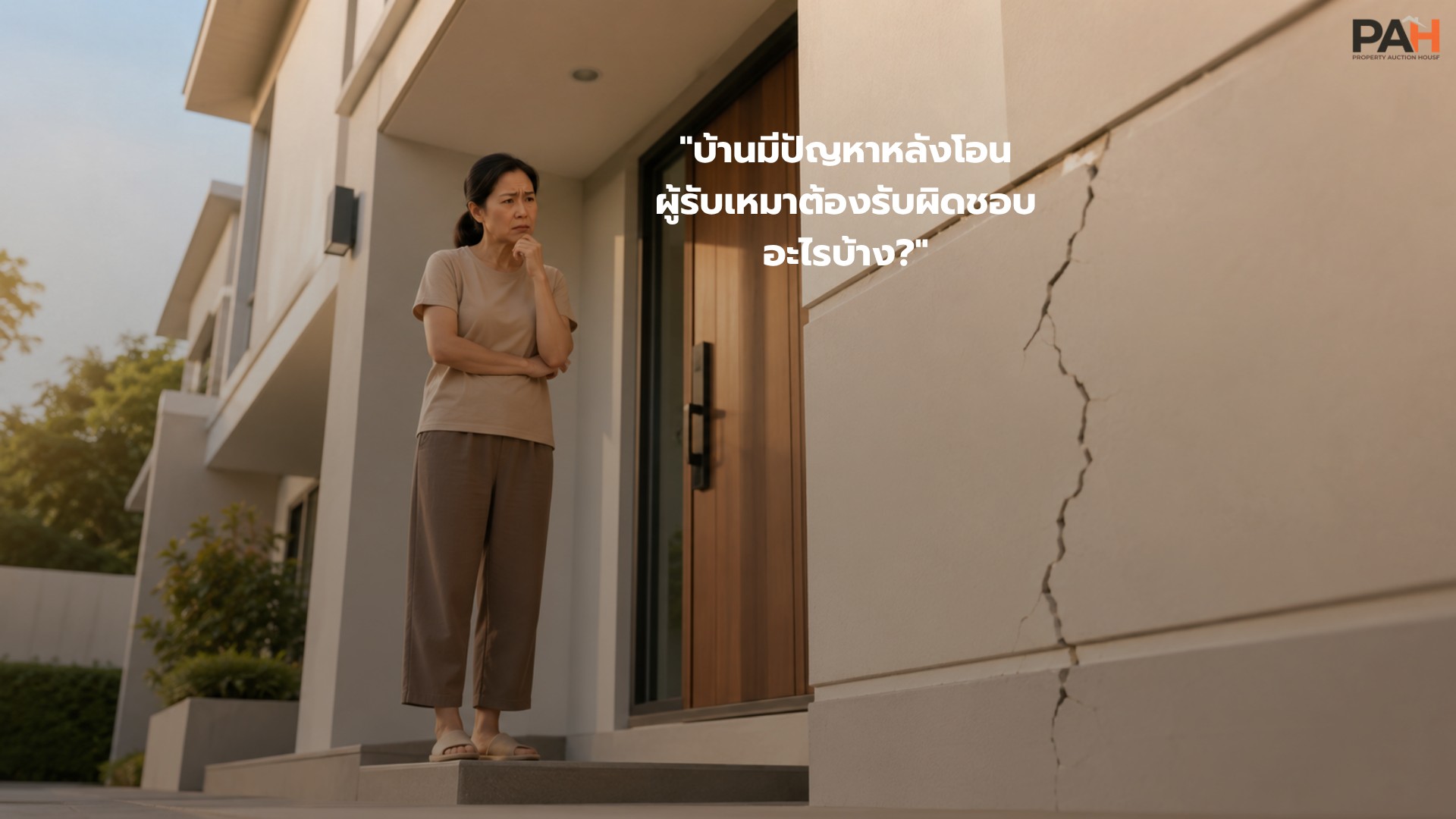
What are the contractor's liabilities for housing defects after the transfer of ownership?
Summary: Contractors or construction companies must be held liable for defects arising from substandard construction work, with a warranty period ranging from 1 to 5 years depending on the type of work, as per Sections 600–601 of the Civil and Commercial Code (CCC). If problems arise, the buyer has the right to demand repairs, claim damages, or take legal action.
1 — Why are post-transfer housing problems still the contractor's responsibility?
Many people mistakenly believe that "once the house is transferred, it's all over." In reality, legal ownership transfer is merely a change of property owner, not a waiver of the construction contractor's liability.
By nature, construction contracts are considered contracts for work under the law. The contractor is obligated to deliver work that is "free from defects." If defects occur due to workmanship or substandard materials, the employer retains the right to make a claim, even after the work has been accepted.
Common misconception: "Signing for the house means giving up all rights" — This is not true. Signing for the handover is only an acknowledgement of delivery, not a waiver of the right to claim for latent defects that have not yet appeared.
2 — What does Thai law say?
The primary governing law is the Civil and Commercial Code (CCC) regarding contracts for work:
Section | Key Essence |
|---|---|
Section 600 | The contractor is liable for defects, even after delivery, if such defects are caused by materials or workmanship of the contractor. |
Section 601 | The statute of limitations for a lawsuit regarding construction defects is 1 year from the date the defect is discovered. |
Section 602 | The employer's right to demand repairs, request a price reduction, or terminate the contract. |
Additionally, other relevant laws include:
Building Control Act B.E. 2522 — Defines structural safety standards.
Consumer Protection Act — In cases where the house is purchased from a real estate developer.
EIT Standards (Engineering Institute of Thailand) — Used as reference standards for engineering work.
3 — What are the contractor's specific responsibilities?
Problem Type | Common Examples | Contractor's Responsibility |
|---|---|---|
Structure | Cracked columns, sagging beams, ground subsidence | Full liability — Repair or compensate |
Roofing | Leaks, loose tiles | Liable — Usually 2–5 years warranty |
Plumbing | Leaking pipes, abnormal water pressure | Liable if caused by installation |
Electrical | Voltage drops, shorts, substandard wiring | Liable per IEC/TIS standards |
Finishing | Loose tiles, peeling paint, molding issues | Usually 1-year warranty |
Doors/Windows | Warped, won't close, degraded seals | Liable if caused by incorrect installation |
Ceiling | Sagging, falling, cracks | Liable unless caused by misuse |
4 — What are the warranty periods for different parts of the house?
Warranty periods vary by type of work. Standard practices in Thailand:
Structural work (5 years): Columns, beams, foundations, load-bearing walls — Longest warranty period due to life safety implications.
Roofing and waterproofing (2–5 years): Roof waterproofing, roofing sheets, thermal insulation — Depends on material and contract.
Plumbing and Electrical (1–2 years): Piping installation, wiring, sanitary systems.
Interior finishing (1 year): Tiles, paint, door frames, ceilings.
Note: The actual warranty depends on your construction contract — always check your contract as some projects may offer longer periods.
5 — How to properly file a claim against a contractor?
Step 1: Document evidence. Take photos and videos of all problem areas with dates, note the nature of the damage, and keep all construction contract documents.
Step 2: Notify in writing. Send a formal letter to the contractor requesting repairs, clearly specifying the issues and a deadline. Send via registered mail (keep proof of postage).
Step 3: Wait for a reasonable response. Generally, allow 15–30 days depending on urgency. If the issue is a safety hazard, set a shorter deadline.
Step 4: Monitor and record. Keep records or screenshots of all communication (phone calls, emails, LINE).
Step 5: Take legal action if necessary. If the contractor does not respond by the deadline, proceed with the steps in the next section.
6 — What if the contractor refuses to be responsible?
Option 1: Complaint to the Office of the Consumer Protection Board (OCPB). Suitable if the house was purchased from a real estate developer — offers mediation without court litigation.
Option 2: Complaint to the Department of Public Works and Town & Country Planning. In cases involving construction standards and permits.
Option 3: Civil Lawsuit. Claim for repair costs, damages, and loss of opportunity — must be filed within the 1-year statute of limitations from the discovery of the defect (Section 601).
Option 4: Consumer Court. For cases not exceeding 300,000 THB, you can file a lawsuit yourself without a lawyer.
FAQ Schema — 8 People Also Ask Questions
Q1: How many months after transfer can I still sue for defects? A: Under CCC Section 601, there is a 1-year statute of limitations from the day the defect is discovered, not the transfer date. If a problem is discovered late, you can still sue within 1 year of discovery.
Q2: Can I still claim damages after signing the house handover? A: Yes. Signing the handover is not a waiver of rights. You can still claim for latent defects that were not apparent on the handover day.
Q3: If I buy from a project, is the developer responsible like a contractor? A: Yes. Real estate developers are responsible and are also subject to the Consumer Protection Act, which provides additional coverage.
Q4: How many years should a contractor warranty a house? A: Depends on the work — Structure 5 years, Roofing 2–5 years, Systems 1–2 years, Finishing 1 year (typically).
Q5: What are the issues for which a contractor is *not* responsible? A: Damage caused by resident misuse, natural disasters not covered in the contract, and modifications made by the buyer after the transfer.
Q6: Must I notify the contractor in writing? A: Not legally required, but highly recommended as it is vital evidence for potential legal proceedings.
Q7: What if the contractor disappears or closes their business? A: You can still sue the individual or legal entity if within the statute of limitations. For closed businesses, check the business registry and proceed through the liquidation process.
Q8: Which agencies provide mediation? A: OCPB, Department of Public Works, Court Mediation Centers, and the Lawyers Council of Thailand (provides free consultations).
Conclusion + CTA
Buying a house is one of life's biggest investments. Knowing your legal rights is just as important as choosing a good location. If you encounter problems after transfer, the first steps should be: Document Evidence → Notify in Writing → Follow up within the Deadline. If the contractor remains unresponsive, there are always legal channels available to protect your rights.