Why is infrastructure the most powerful "price driver"?
In the world of real estate, there is a formula that professional investors know by heart: "Location + Infrastructure = Value." Every time the government announces a major project—whether it's a new mass transit line, an expressway, or a special economic zone—land prices within that radius usually adjust upward immediately, even before the project is completed.
Data from the Real Estate Information Center (REIC) of the Government Housing Bank clearly indicates that the price index for undeveloped land in Bangkok and its metropolitan regions rose by 2.9% YoY in Q3 2024 and is expected to continue accelerating in 2025, driven primarily by the progress of the mass transit network, which is expanding to cover the entire city.
5–12%
Average increase in Bangkok land appraisal prices (2025)
8–10%
Increase along new mass transit lines
24.9%
EEC land price index jump YoY (Q1/2025)
1 Million+
Baht/sq.wah, highest price (Silom-Ploenchit)
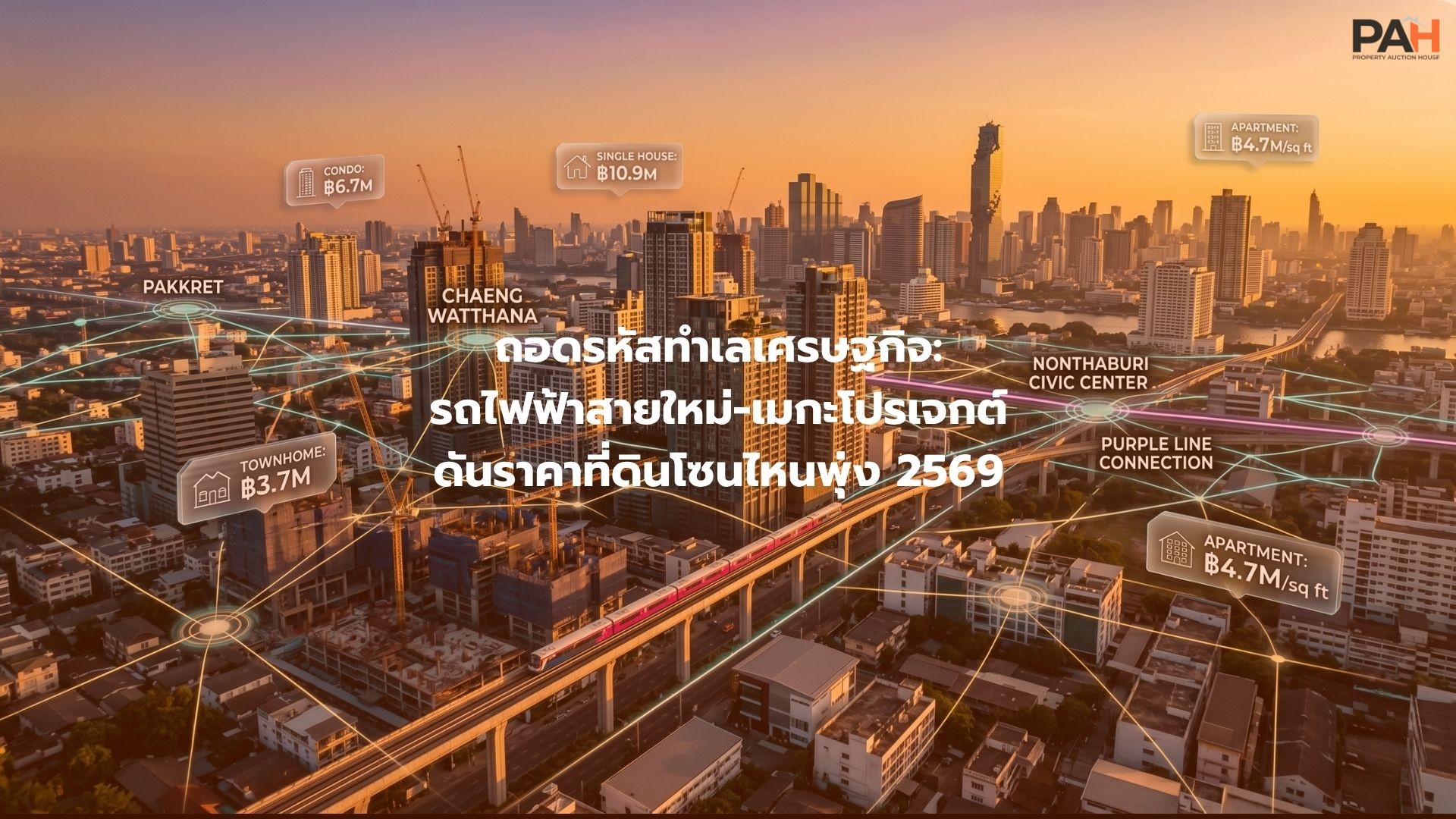
11 New Mass Transit Lines: An explosive force for transformation
The Ministry of Transport is expediting 11 new mass transit lines, targeting operations between 2028–2029 with a total budget of over 200 billion baht. Each line traverses areas where land prices are still relatively low, creating a golden opportunity for investors who enter the market before the hype begins.
Lines to watch closely include the Light Red Line extension (Bang Sue–Phaya Thai–Makkasan–Hua Mak) and the Brown Line (Khae Rai–Lam Sali), which will open doors to secondary locations that currently hold high potential but have not yet seen price surges.
6 economic locations with "skyrocketing prices" to watch
Based on an analysis of the Treasury Department's 2025–2026 appraisal data, combined with ongoing infrastructure plans, here are 6 zones to monitor:
+10% ↑
1. Sukhumvit-Asok (Eastern Bangkok)
An intersection of multiple transit lines: BTS + MRT + Airport Link. The new appraisal price at Asok intersection has increased from 210,000 to 750,000 baht/sq.wah, continuing to grow due to the demand for the last remaining plots in the CBD.
+8–10% ↑
2. Makkasan-Phaya Thai-Ratchaprarop
The Light Red Line "Missing Link" will connect this area directly to Suvarnabhumi Airport. Land prices are beginning to shift even before project completion. The area has high potential for mixed-use development.
+8% ↑
3. Bang Yai-Ngam Wongwan (Nonthaburi side)
The Brown Line (Khae Rai–Lam Sali) passes through the Ngam Wongwan road corridor, connecting the Purple and Pink lines. Land prices remain significantly lower than in inner Bangkok, making it a secondary location with high expansion trends.
+8% ↑
4. Lat Phrao-Nawamin-Krungthep Kreetha
The Brown Line extension (Prasoet Manotkit–Nawamin) opens the door to the northeast. Land prices are still below the urban average, but demand is starting to heat up.
+25% ↑
5. EEC — Chonburi-Rayong-Chachoengsao
The EEC land price index jumped 24.9% YoY in Q1 2025, supported by foreign investment totaling 47.033 billion baht (+31% YoY) from Japan, China, and Singapore. The Laem Chabang Port Phase 3 and Map Ta Phut Phase 3 are key catalysts.
+7–9% ↑
6. Salaya-Bang Yai-Lam Luk Ka (Western-Northern outskirts)
Secondary locations that haven't fully peaked yet. Prices are accessible, and mixed-use projects from major groups like Origin and MQDC have already begun development. Ideal for investors looking to "buy before the trend."
Mega-projects to follow: Catalysts greater than mass transit
Beyond mass transit, several national mega-projects are transforming the landscape of Thailand, including:
Laem Chabang Port Phase 3 — Increases cargo capacity, driving demand for logistics land in the Chonburi zone.
Map Ta Phut Industrial Port Phase 3 — Supports petrochemical and New S-Curve industries in Rayong.
U-Tapao Airport — A new aviation hub connecting the EEC to the global stage, sparking significant activity in the Pattaya-Chonburi zone.
EEC Smart City — A project designed to attract global tech companies, creating an unprecedented ecosystem in Thailand.
High-Speed Rail linking 3 Airports — Connecting Don Mueang–Suvarnabhumi–U-Tapao, significantly increasing land value along the entire route.
Strategy for investors: Read the game, enter early to gain an edge
Data reaffirms that land prices in Bangkok and its periphery rise by an average of 5–10% annually, while the EEC is growing more than twice as fast. Wise investors should not wait for projects to finish before buying, as by then, prices will have already fully reflected the public information.
The simple principle is: Buy when there is "news" and sell when the "project launches." Or, if your goal is long-term holding, new transit lines currently in the construction phase (such as the Brown Line or the Western section of the Orange Line) are zones that still offer value entry points.
Conclusion: Economic locations — Reading infrastructure maps is reading the future
In an era where Thailand is simultaneously investing hundreds of billions of baht in infrastructure, the ability to read mass transit and mega-project maps before others is a competitive advantage that can be converted into real returns. You should consistently study appraisal data from the Treasury Department, the REIC index, and transport master plans to make decisions based on data, not just hype.
Note for investors: Land prices and index figures are referenced from the Treasury Department and the Real Estate Information Center (REIC), Government Housing Bank (2024–2025). This article is provided for informational purposes for decision-making and is not investment advice. Please consult a real estate expert before every investment.
Article content is based on actual data from the Treasury Department regarding the 5–12% average land appraisal increase and the 8–10% increase around new mass transit lines Futuredeveloperacademy, as well as the 24.9% YoY increase in the EEC land price index in Q1 2025, driven by foreign investment from Japan, China, and Singapore DDproperty, and the plan to expedite 11 new mass transit lines scheduled to open by 2028–2029 Thansettakij