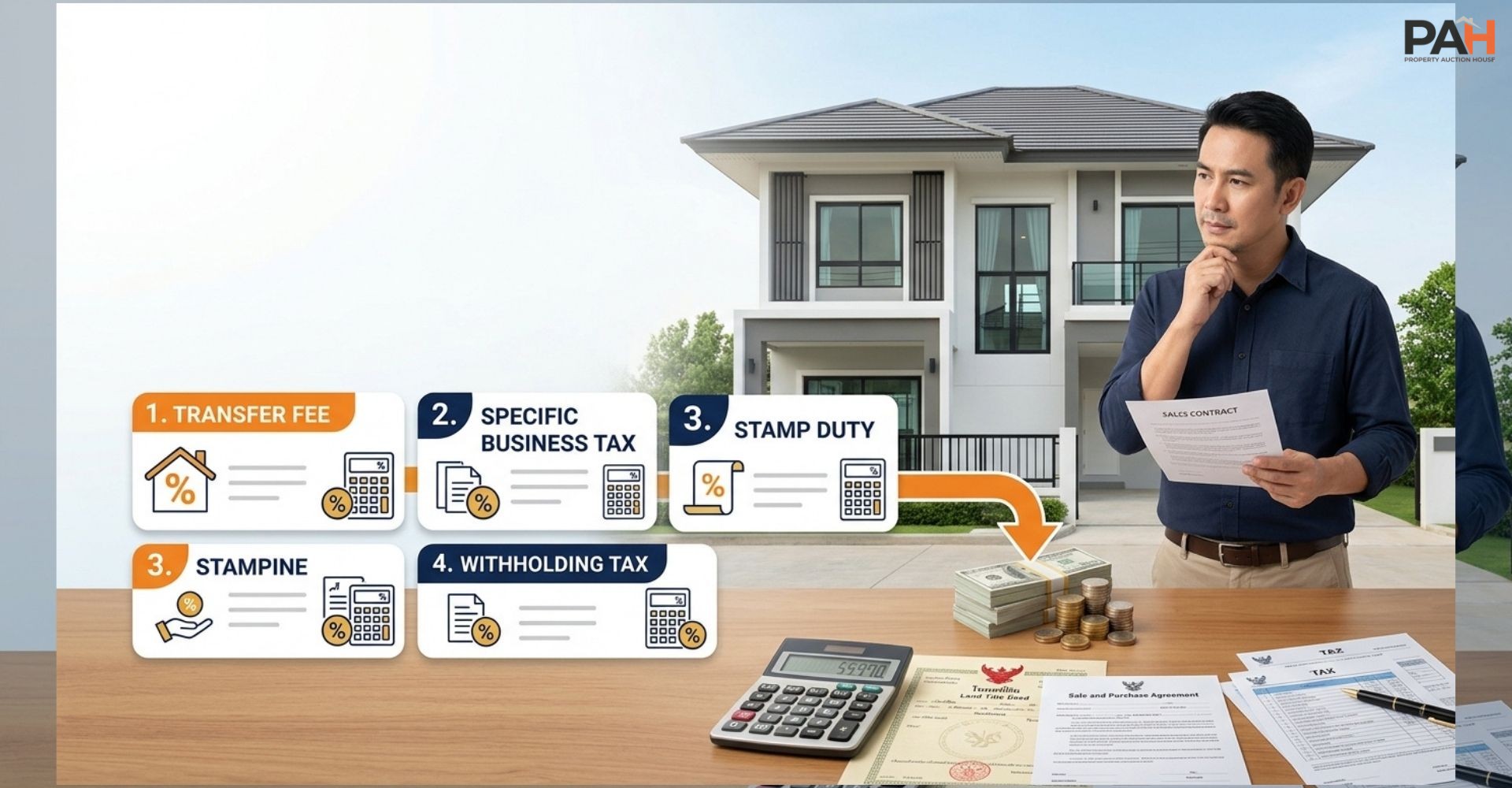
Selling a house or real estate doesn't end just with agreeing on a price with the buyer. When the transfer of ownership day arrives at the Land Department, you will encounter several "taxes and fees" that could unexpectedly eat into the amount you receive.
There are 4 main items of taxes and fees associated with selling a home:
Transfer of ownership fee
Specific Business Tax (or Stamp Duty — choose one)
Withholding Tax
Each item has different conditions, rates, and calculation methods. This article will explain every point in full, along with real calculation examples.
1. Transfer of Ownership Fee
What is it?
A fee charged by the Land Department when ownership of real estate is transferred. It is not a tax but a government service fee.
Rate
2% of the appraisal price (the appraisal price set by the Land Department, not the actual selling price).
Who pays?
Usually shared between the seller and the buyer (1% each), but this depends on the agreement.
Example
Appraisal price of land + building = 3,000,000 Baht
Transfer fee = 3,000,000 × 2% = 60,000 Baht
💡 Note: The government occasionally implements measures to reduce transfer fees, especially during periods to stimulate the real estate market. You should check for the latest measures with the Land Department or their official website.
2. Specific Business Tax
What is it?
A tax collected by the Revenue Department for the sale of real estate in a business or profit-seeking manner.
Rate
3.3% of the selling price or the appraisal price, whichever is higher (comprising 3% Specific Business Tax + 0.3% local tax).
Conditions for payment
The seller must pay Specific Business Tax if they meet any of the following criteria:
Ownership is held for less than 5 years from the date of acquisition.
Name has been on the house registration (Tabien Baan) of the property being sold for less than 1 year before the sale.
Selling more than 1 property in the same year (in the case of an individual).
Exemptions for Specific Business Tax
Held for over 5 years and name in house registration for over 1 year → Exempt from Specific Business Tax (must pay Stamp Duty instead).
Acquired by inheritance.
Transferred to legitimate children (excludes adopted children).
Example
Selling price = 4,000,000 Baht, Appraisal price = 3,500,000 Baht
Use the higher price = 4,000,000 Baht
Specific Business Tax = 4,000,000 × 3.3% = 132,000 Baht
3. Stamp Duty
What is it?
A duty fee for the real estate sale contract. It is used instead of the Specific Business Tax in cases where Specific Business Tax is not applicable.
Rate
0.5% of the selling price or the appraisal price, whichever is higher.
Conditions
The seller pays Stamp Duty instead of Specific Business Tax when the property has been held for over 5 years and does not fall under the Specific Business Tax criteria.
⚠️ Important: Stamp Duty and Specific Business Tax are only paid one or the other, never both at the same time.
Example
Selling price = 4,000,000 Baht
Stamp Duty = 4,000,000 × 0.5% = 20,000 Baht
4. Withholding Tax
What is it?
An income tax deducted from every seller when ownership is transferred. It is calculated based on the profit gained from the sale.
Calculation formula for individuals
The Revenue Department calculates this based on the appraisal price (not the actual selling price), using the following steps:
Step 1: Deduct lump-sum expenses. The Revenue Department sets deduction rates based on the number of years of ownership:
Years of ownership
Deduction %
1 year
92%
2 years
84%
3 years
77%
4 years
71%
5 years
65%
6 years
60%
7 years
55%
8 years or more
50%
Step 2: Divide by the number of years held. Annual net income = (Appraisal price × (100% - deduction %)) ÷ number of years held.
Step 3: Calculate tax using the progressive rate. Apply the annual net income to the progressive personal income tax rates, then multiply back by the number of years.
Example of Withholding Tax calculation
Assumption:
Appraisal price = 3,000,000 Baht
Ownership = 5 years
Deduction rate = 65%
Steps:
Expenses = 3,000,000 × 65% = 1,950,000 Baht
Total net income = 3,000,000 - 1,950,000 = 1,050,000 Baht
Annual net income = 1,050,000 ÷ 5 = 210,000 Baht
Calculate annual tax (progressive rate):
First 150,000 → Exempt = 0 Baht
150,001–300,000 (5%) → 60,000 × 5% = 3,000 Baht
Tax per year = 3,000 Baht
Total tax = 3,000 × 5 = 15,000 Baht
Overview Summary: Selling a house for 4,000,000 Baht (Held for 3 years)
Item
Rate
Amount (Approx.)
Payer
Transfer Fee
2% of appraisal
60,000–80,000 Baht
Seller/Buyer (Agreed)
Specific Business Tax
3.3% of max price
132,000 Baht
Seller
Withholding Tax
Progressive rate
Varies by case
Seller
The seller's total expenses may be 3–6% of the selling price, depending on the conditions of each case.
Frequently Asked Questions (FAQ)
Q: If I sell my only house, is it tax-exempt? A: You are exempt from Withholding Tax if your name has been on the house registration for at least 1 year prior to the sale and the sale is to purchase a new home. However, you must still pay the transfer fee and Specific Business Tax as usual.
Q: Can Specific Business Tax and Stamp Duty be paid at the same time? A: No, you must pay only one. If you fall under the Specific Business Tax criteria, you are automatically exempt from Stamp Duty.
Q: How is the holding period counted? A: It is counted from the date of ownership transfer from the previous owner to the date of transfer to the new owner, counting full years by the calendar. Incomplete years are not counted.
Q: If I inherited the house, do I have to pay Specific Business Tax? A: In the case of inheritance, you are exempt from Specific Business Tax, but you must still pay Stamp Duty and Withholding Tax as normal.
Things to do before selling a house
Check the appraisal price from the Land Department to estimate your tax burden in advance.
Count your holding period accurately as it directly affects the Specific Business Tax.
Verify how long your name has been on the house registration as it is an important condition.
Consult with a real estate tax expert, especially in complex cases like inheritances, transfers to children, or having multiple properties.
Agree with the buyer in advance on who will be responsible for which expenses.
Conclusion
Selling a house involves tax burdens that must be planned for in advance, including the 2% transfer fee, 3.3% Specific Business Tax (or 0.5% Stamp Duty if held for over 5 years), and Withholding Tax calculated based on the holding period and progressive rates. If you plan well from the beginning, you will be able to accurately estimate your actual profit and avoid having your profits eaten by taxes without realizing it.