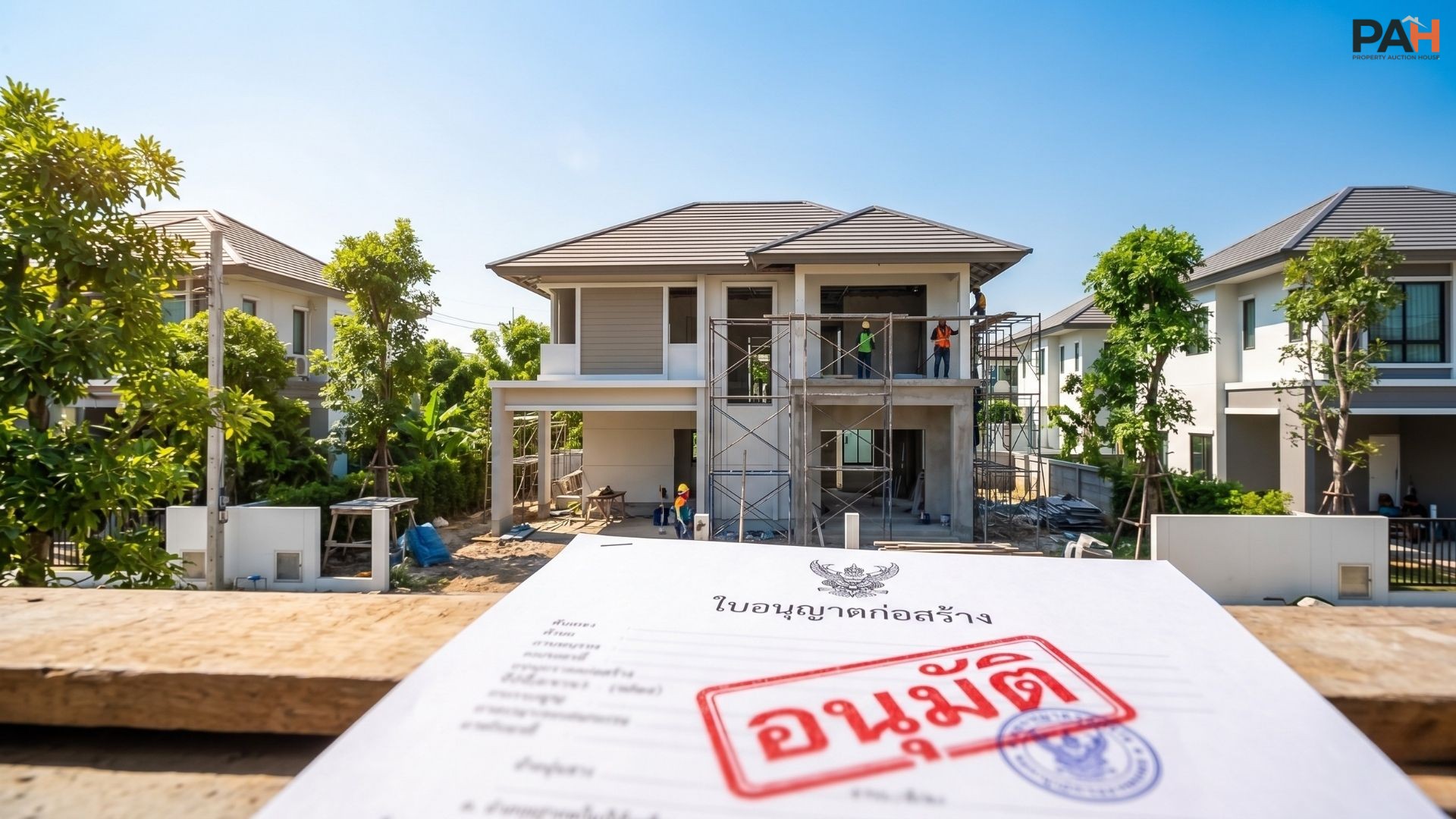
Steps to Obtain a Building Permit for a New House on Your Own Land — Do It Yourself, No Agent Needed
A step-by-step guide, from preparing blueprints to receiving the permit, including a document checklist, fees, and things to watch out for before starting construction.
Why Do You Need a Building Permit?
According to the Building Control Act B.E. 2522 (1979) and its amendments, construction of a residential house on your own land must always be authorized by a building permit, regardless of whether you own the land. Failure to comply can result in a fine of up to 60,000 THB and potential orders to demolish the entire structure.
Answer: Building a house on your own land without a permit is a violation of the law, punishable by fines and demolition orders.
7 Steps to Obtain a House Building Permit
Step 1 — Hire an architect to draw plans and calculate structures
The submitted plans must be prepared by a licensed architect or engineer. This includes architectural drawings, structural engineering designs, electrical systems, and sanitary systems. Generally, design fees range from 50,000 to 200,000 THB, depending on the size of the house.
Step 2 — Prepare all required documents before submission
Documents that must be prepared include:
Document | Details |
|---|---|
Building permit application (Form A.1) | Fill out according to the local form |
Land title deed / Nor Sor 3 | Original plus a copy |
Construction blueprints | Signed by a licensed architect/engineer |
Owner's ID card + House registration | 2 copies |
Written consent from the landowner (if not the same person) | If there is a co-owner |
Engineer's certificate (for high-rise or large buildings) | Issued by EIT |
Step 3 — Submit the application to the local administrative organization
Where you submit depends on the land location:
Bangkok → District Office
Pattaya City → Pattaya City Hall
Municipal Area → Municipal Office
Outside Municipal Area → Subdistrict Administrative Organization (SAO/OrBorTor)
Currently, some localities accept online submissions through the Department of Public Works and Town & Country Planning's e-Building Permit system.
Step 4 — Officials review the plans and inspect the site
After submission, officials will verify the accuracy of the plans, setback requirements from roads and boundaries, and zoning compliance. This process takes 15–30 days. If the plans are not approved, a notice for corrections will be issued within 7 days.
Step 5 — Pay the fees
Building permit fees are calculated based on usable area, typically ranging from 0.5 to 4 THB per square meter, depending on the building type and locality. For a standard 150-square-meter house, the fee is approximately 500–1,500 THB.
Step 6 — Receive the building permit (A.1)
Once fees are paid, you will receive the Building Permit (Form A.1), which is valid for 1 year (renewable for 1 year at a time). This permit must be displayed at the construction site throughout the duration of the work.
Step 7 — Notify the commencement of work and proceed with construction
Before starting construction, you must notify the agency in writing at least 3 days in advance. You must also have an engineer or architect supervise the work as required by law and notify the agency of the completion to request an "Occupancy Permit (A.6)" once the work is finished.
Overall Timeline
Process | Estimated Time |
|---|---|
Design and plan preparation | 2–4 weeks |
Document preparation | 3–7 days |
Waiting for decision | 15–30 days |
Receive permit (after paying fees) | 1–3 days |
Total | Approximately 45–60 days |
Frequently Asked Questions (FAQ)
Q: Do I need a permit to build on my own land? A: Yes, a permit is required in all cases, according to Section 21 of the Building Control Act B.E. 2522, with no exceptions for private property.
Q: How long does it take to get a building permit? A: On average, 30–45 days from the date of complete document submission. If documents are incomplete or plans need revision, it may take 60–90 days.
Q: What happens if I don't get a building permit? A: There is a fine of up to 60,000 THB, plus a daily fine of up to 10,000 THB until the issue is rectified or demolished. You may also be ordered to demolish the entire building.
Q: Can I build a house on land owned by someone else? A: Yes, but you must have a signed letter of consent from the landowner or a notarized power of attorney.
Q: Can I use stock house plans from the internet to apply for a permit? A: Yes, but you must have a licensed architect/engineer sign and certify the plans before submission. Never submit plans that have not been certified.
Things to Watch Out For
Common mistakes that lead to permit denial include: insufficient road or boundary setbacks according to zoning, exceeding the Floor Area Ratio (FAR), the signing architect/engineer's license having expired, and the land being in a special control zone (e.g., wetlands or conservation areas).
Conclusion
Obtaining a permit for a house on your own land is not as complicated as it seems. If you prepare your documents and use a legally qualified architect/engineer, the entire process takes about 45–60 days. Completing this step ensures your house is legal, eligible for bank loans, and easy to resell in the future without issues.