Home Buying and Selling Laws in Thailand That Buyers and Sellers Must Know
Contracts, Ownership Transfer, Encumbrances, and Taxes — The complete legal structure of a transaction in one place.
Buying or selling a home in Thailand is not merely a matter of handing over a building and making a payment. It is a complex legal transaction because, under the law, a house is considered an accessory to the land, meaning the sale must comply with multiple laws simultaneously.
Whether you are a buyer seeking assurance of full ownership or a seller aiming to minimize tax burdens and avoid disputes, understanding the legal framework is indispensable.
This article provides a comprehensive explanation of every dimension, from the Civil and Commercial Code governing contracts, the Land Code Act defining ownership transfers, and encumbrances to be verified before purchase, to the taxes and Land Department regulations applicable on the day of transfer.
Why You Must Understand the Law When Buying or Selling a Home
Many people believe that buying or selling a home is simple: agree on a price, sign a contract, and hand over the keys. In reality, if any step is legally flawed, the consequences can be severe, such as:
Ownership failing to transfer completely, even after full payment.
The buyer unknowingly inheriting encumbrances, such as mortgages or liens.
Disputes regarding possession rights that could lead to litigation.
Tax liabilities significantly higher than expected.
The laws governing home transactions in Thailand are not contained in a single document but are a collective application of civil law, land law, tax law, and government agency regulations. Understanding this structure is the heart of a secure transaction.
1. Civil and Commercial Code — The Foundation of Sales Contracts
Under Thai law, a home sale is considered a sale of real estate, which falls under the sections of the Civil and Commercial Code regarding juristic acts and contracts. This code lays the essential foundation in several areas.
Validity of the Sales Contract
For a house sales contract to be legally valid under the Civil Code, it must contain all necessary components: parties with the legal capacity to act, genuine intent from both buyer and seller, a clearly defined object of the contract, and an agreed-upon price.
Rights and Duties of the Parties
The Civil Code mandates that the seller is responsible for delivering the property in the agreed condition and is liable for hidden defects. Meanwhile, the buyer has the duty to pay the price as specified.
Liability for Breach of Contract
If either party breaches the contract, the other party has the right to terminate the contract and claim damages, which in practice often involves provisions regarding a deposit.
Important Note: Even if a sales contract is valid under the Civil Code, ownership of the house will not transfer to the buyer unless the ownership transfer is registered according to the Land Code.
2. House Ownership Cannot Be Separated from Land Ownership
This is a principle many overlook and is the cause of numerous disputes.
Under Thai law, a house is considered an accessory to the land according to Section 144 of the Civil and Commercial Code. This means that a structure permanently attached to the land is automatically part of the land, unless specific rights are established separately by law, such as in the case of surface rights.
Because of this, the sale of a house must comply with the Land Code Act, B.E. 2497 (1954), which governs:
Land rights and types of title deeds.
Proper ownership transfer procedures.
Restrictions on land ownership, such as in the case of foreigners.
The authority of land officials.
The agency responsible for enforcing this law is the Department of Lands under the Ministry of Interior.
3. Ownership Must Be Registered at the Land Office Only
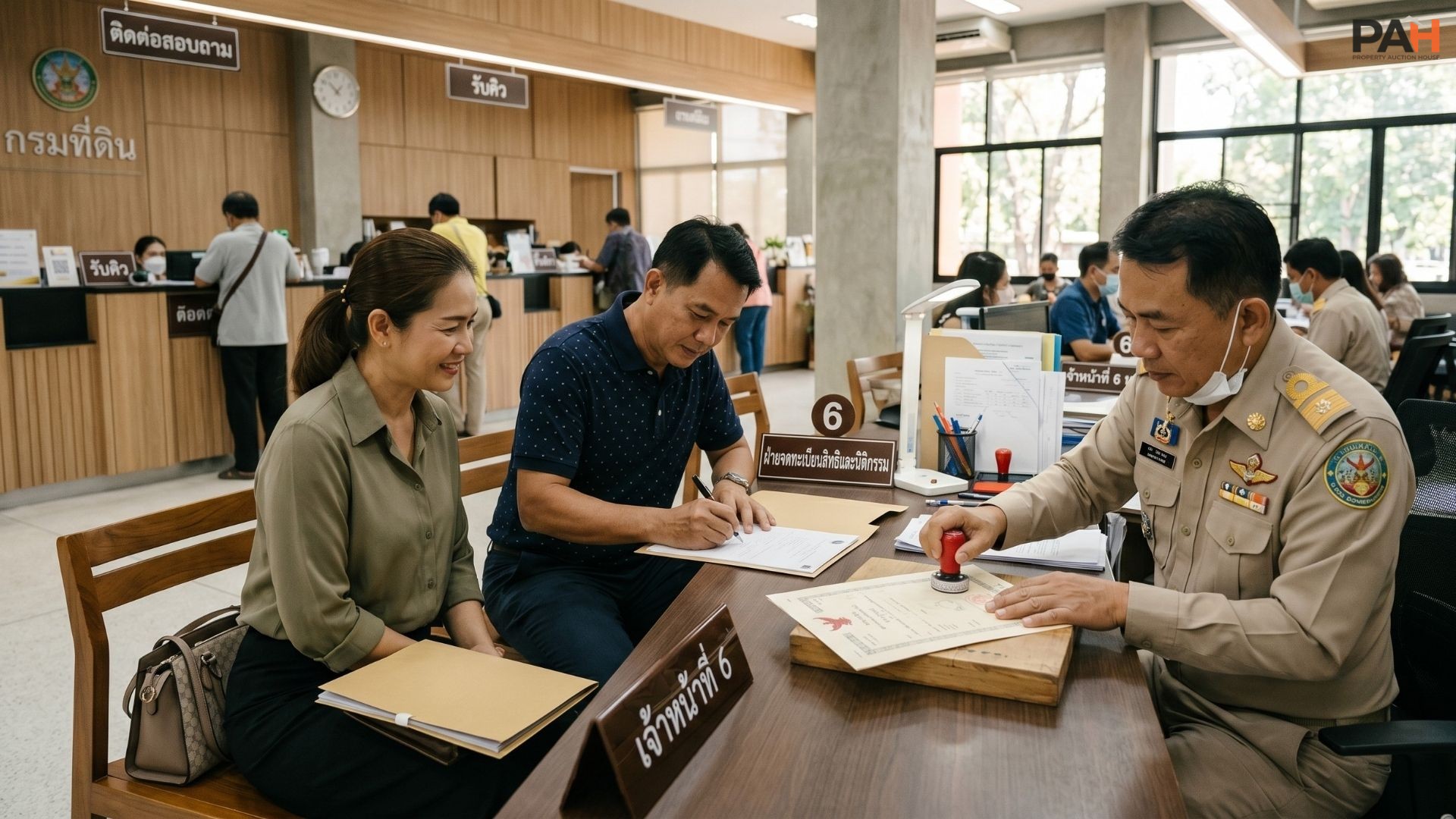
The Land Code establishes a crucial principle with no exceptions: the transfer of home and land ownership is only complete when registered with an official at the Land Office.
What Is Insufficient for Transferring Ownership
The following actions, even if completed in full, do not legally transfer ownership:
Signing a sales contract alone.
Making full payment.
Handing over the house and keys to the buyer.
If the transfer is not registered at the Land Office, the buyer is not legally the owner of the house, and the seller can still perform other transactions with the property, such as mortgaging it or selling it to someone else.
Proper Transfer Procedure
The ownership transfer is complete once the official accepts the registration, records it in the land registry, and issues the proof of transfer, which will appear on the back of the land title deed.
Documents Required for the Transfer Day
Generally, required documents include the original land title deed, national ID cards of both parties, household registration, power of attorney (if not appearing in person), and spousal consent (if applicable).
4. Encumbrances to Verify Before Buying a Home
Even if a house and land can have their ownership transferred, if there are encumbrances, the buyer might inadvertently inherit risks. These must be checked thoroughly before deciding to buy.
Common Types of Encumbrances
Land or Home Mortgage: The most common encumbrance, resulting from the previous owner using the land as collateral for a loan from a bank or financial institution. If not discharged before or on the day of transfer, the buyer will receive a house still under mortgage.
Court or Execution Officer Lien: Occurs when there is a legal case involving the land, preventing ownership transfer until the case is resolved.
Registered Lease Rights: If there is a long-term registered lease, the tenant still has the right to occupy the property according to the contract, even if the owner changes.
Servitude: A right that a third party has over the land, such as a right of way, utility access, or light rights, which usually remains with the land even after a change of ownership.
How to Verify Encumbrances
Buyers should check from two main sources:
The Back of the Land Title Deed: Which records juristic acts and various encumbrances previously registered.
The Rights and Juristic Acts Registry at the Land Office: You can request a search directly to obtain the most recent and complete information.
Verifying these details before signing a contract will help significantly in preventing potential problems.
5. Tax Laws Related to Home Sales
Taxes are one of the expenses that many people underestimate when buying or selling a home. Planning taxes in advance is very important. Tax laws are under the supervision of the Revenue Department.
Personal Income Tax from Selling a Home
Individual sellers are liable for income tax on the proceeds from the sale. The calculation uses the Land Department's appraisal price as a base, deducting standard expenses based on the number of years held, and applying the personal income tax rate. The longer it is held, the more expense deductions are allowed.
Specific Business Tax
The seller must pay a Specific Business Tax at a rate of 3.3% of the sale price or appraisal price, whichever is higher, if selling within 5 years from the date of acquisition (with some exceptions, such as a primary residence lived in for at least 1 year).
Stamp Duty
In cases where Specific Business Tax is not applicable, Stamp Duty must be paid instead at a rate of 0.5% of the sale price or appraisal price, whichever is higher.
Transfer Fees
In addition to taxes, there is a transfer fee payable to the Land Department at a rate of 2% of the appraisal price. Generally, the buyer and seller agree to split this cost equally.
Recommendation: Tax and transfer expenses should be planned in advance and clearly summarized in the sale and purchase agreement, stating which party is responsible for which item to prevent conflicts on the day of transfer.
6. Land Department Regulations on the Day of Transfer
Even if you fully understand the main laws, transferring ownership must follow the Land Department's actual procedures on the day of transfer, which involves many important practical details.
Documents Required on the Transfer Day
The Land Department clearly specifies the documents that must be brought on the day of transfer. Missing even one document might require rescheduling, which could be problematic if the contract has time-sensitive conditions.
Managing Existing Encumbrances on the Transfer Day
In cases where a house is mortgaged, there are several ways to proceed, such as discharging the mortgage before the transfer (where the seller settles the debt with the bank) or transferring the mortgage (where the buyer assumes the burden, requiring creditor consent). Alternatively, if the buyer is also taking out a new mortgage to purchase, the new lending bank will settle the old debt and register the new mortgage on the same day.
Fees and Payments at the Land Office
All fees and applicable taxes must be paid at the Land Office on the day of transfer. Both parties should prepare cash or cashier's checks and verify the total amount payable with Land Office officials before the appointment date.
Summary of the Home Sales Legal Structure in Thailand
Buying and selling a home in Thailand involves the combined application of four layers of law:
Law / Regulation | Scope | Agency |
|---|---|---|
Civil and Commercial Code | Contracts, Intent, Rights/Duties, Liability | Courts |
Land Code Act, B.E. 2497 | Ownership Transfer, Encumbrances | Department of Lands |
Tax Law | Income Tax, Specific Business Tax, Stamp Duty | Revenue Department |
Land Department Regulations | Documents, Procedures, Fees | Department of Lands |
Understanding these legal structures comprehensively is the heart of a correct, secure, and long-term risk-mitigated home transaction.
Frequently Asked Questions (FAQ)
Can I buy or sell a home without registering the transfer?
No. Ownership transfer must be registered with an official at the Land Office. If not registered, the transaction is not complete, and the buyer does not have legal ownership, even if payment has been made and the house handed over.
Can a mortgaged home be bought or sold?
Yes, but the method for handling the mortgage must be clearly defined in the contract before the transfer day, whether it is discharging the mortgage first, transferring it, or taking out a new loan to settle the old debt. Clarity here prevents many problems on the transfer day.
Who is responsible for home sales taxes?
It depends on the agreement in the contract. However, the law clearly assigns the duty of the taxpayer: income tax and specific business tax are the seller's burden, while transfer fees are typically split between the parties. This should be explicitly stated in the sale and purchase agreement from the beginning.
Can foreigners buy homes in Thailand?
Foreigners face restrictions on land ownership under Thai law but can own buildings in certain forms, such as condominiums (within the specified quota) or through long-term leasehold rights. Consult a legal expert before performing any transaction.
Is a lawyer necessary for buying or selling a home?
The law does not require it, but for high-value or complex transactions—such as those with encumbrances, co-borrowing, or involving foreign parties—having a legal expert help review the contract and documents can significantly reduce risks.
This article is intended for general knowledge about home sale laws in Thailand. If you have a specific transaction requiring advice, you should consult a lawyer or a land law expert directly.