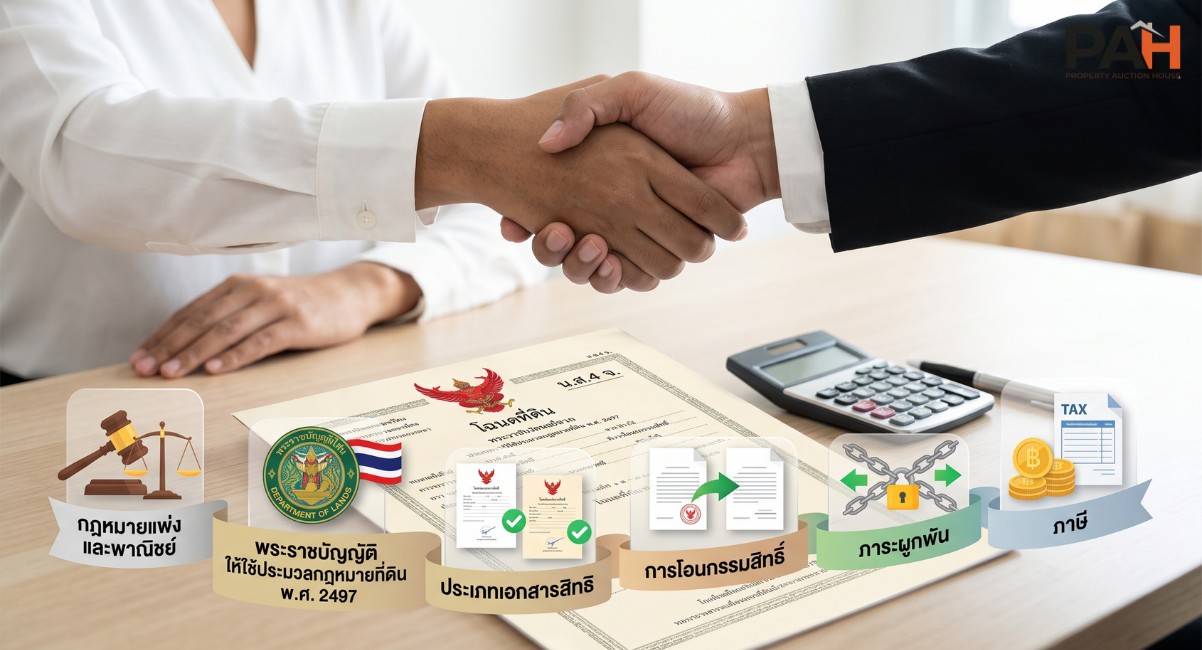
Laws Governing Land Sale and Purchase in Thailand
Title Deeds, Ownership Transfer, Encumbrances, and Taxes You Must Know Before Buying or Selling
The sale and purchase of land in Thailand is a high-risk legal transaction. If buyers or sellers do not fully understand the applicable laws, serious legal problems may arise, such as invalid ownership transfer, hidden encumbrances, or unexpected tax liabilities.
The key principle is:
Land sale transactions in Thailand are not governed by a single law.
They are subject to the combined application of civil law, land law, tax law, and administrative regulations issued by government authorities.
This article explains the complete legal framework specifically governing land sale and purchase in Thailand.
1. Land Sale Must Comply with the Civil and Commercial Code
A land sale is legally classified as a sale of immovable property, which is governed by the Civil and Commercial Code, particularly in relation to juristic acts and contracts.
Key legal principles include:
Mutual consent of the contracting parties
Legal validity of the sale and purchase agreement
Rights and obligations of the buyer and seller
Liability in cases of breach of contract or contract termination
However, even if a written contract is legally valid,
ownership of the land does not transfer unless the transfer is registered with a government officer in accordance with land law.
2. Land Code Act B.E. 2497 (1954)
The Most Fundamental Law Governing Land Transactions
The Land Code Act B.E. 2497 (1954) establishes the entire legal structure of land ownership in Thailand and applies directly to all land sale transactions.
This law governs:
Types of land title deeds
Conditions for ownership transfer
Restrictions on land ownership
Powers and duties of land officers
The enforcing authority is the Land Department.
3. Types of Land Title Deeds Eligible for Sale
Not all land title documents have the same legal status.
The type of title deed must be examined first in any land transaction.
Common types include:
Chanote (Nor Sor 4 Jor) – Full ownership, freely transferable
Nor Sor 3 Gor – Transferable, but requires official land measurement
Nor Sor 3 / Nor Sor 3 Kor – Subject to legal limitations and higher risk
Buyers should verify:
Whether the title deed is legally transferable
Whether any legal or regulatory restrictions apply
4. Ownership Transfer Must Be Registered Only
Land law clearly stipulates that:
Ownership transfer of land must be registered with a Land Officer at the Land Office.
If there is only:
A sale and purchase agreement
Payment receipts
Physical handover of land
but no registered transfer,
legal ownership does not change, and the buyer is not the lawful owner.
Ownership transfer is legally complete only when:
The Land Officer registers the transfer
The transaction is recorded in the land register
An official transfer record is issued
5. Encumbrances That Must Be Checked Before Buying Land
Even if land is transferable, hidden encumbrances may expose buyers to serious legal risks.
Common encumbrances include:
Mortgages
Court seizure or enforcement orders
Servitudes (right of way, pipelines, power lines)
Registered lease rights
Verification must be done by reviewing:
The reverse side of the title deed
The official land registration records at the Land Office
6. Tax Laws Related to Land Sale Transactions
Land sale transactions are subject to several taxes regulated by the Revenue Department.
Relevant taxes include:
Personal Income Tax on land sale
Specific Business Tax (in certain cases)
Stamp Duty (when Specific Business Tax does not apply)
Improper tax planning may cause sellers to bear excessive and unnecessary tax burdens.
7. Land Department Regulations on Registration of Rights and Juristic Acts
Laws Applied in Practice on the Transfer Date
In addition to statutory laws, ownership transfer must comply with
Regulations on the Registration of Rights and Juristic Acts issued by the Land Department.
These regulations determine:
Required documents on the transfer date
Transfer and registration fees
Methods of recording encumbrances
Procedures for sale transactions involving mortgages
Summary of Land Sale Laws
Land sale and purchase in Thailand
must comply with:
Civil and Commercial Code
Land Code Act B.E. 2497 (1954)
Tax laws
Land Department regulations
A complete understanding of these laws is essential for safe, lawful, and risk-free land transactions in Thailand.
FAQ: Land Sale and Purchase in Thailand
Q: Can land be sold without registration at the Land Office?
No. Ownership transfer must be registered with a Land Officer; otherwise, the transaction is legally invalid.
Q: Can mortgaged land be sold?
Yes, but the mortgage release or transfer arrangement must be clearly defined.
Q: Where can land encumbrances be verified?
They can be verified through the land register and the reverse side of the title deed at the Land Office.