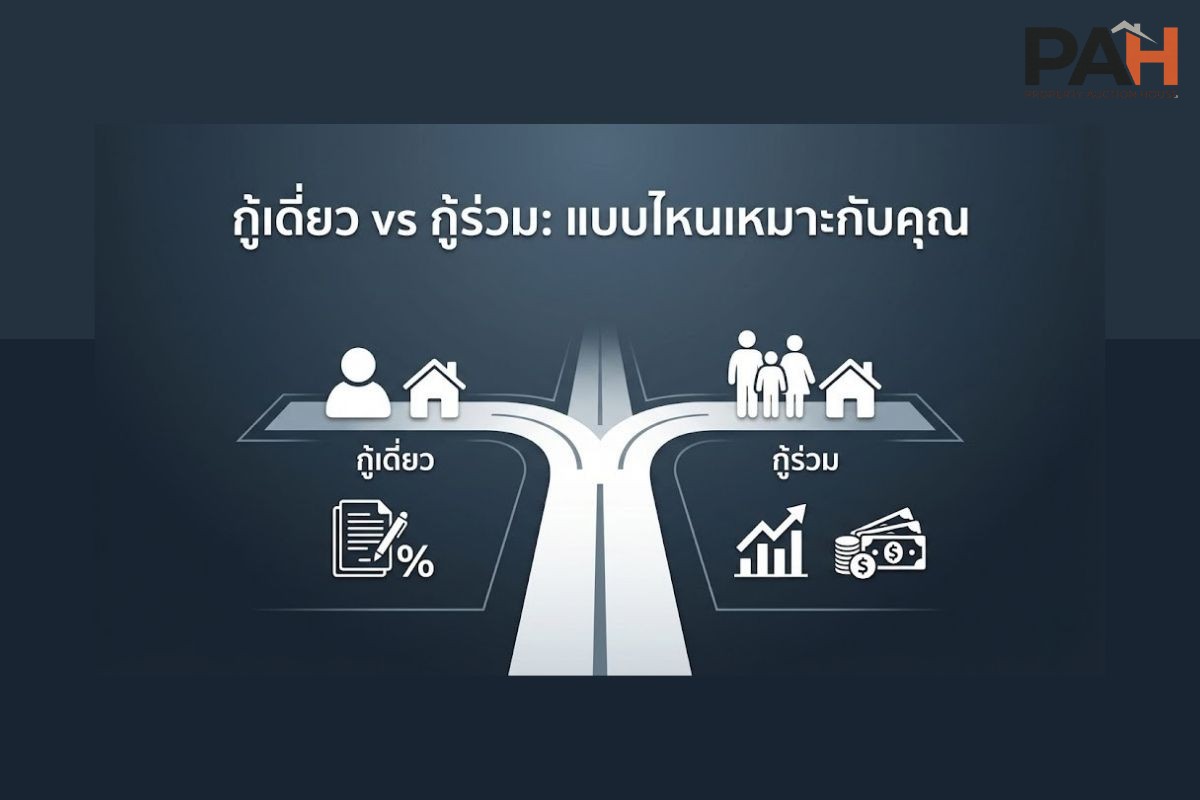
A Critical Crossroad for Aspiring Homeowners
With housing and condominium prices skyrocketing while incomes stagnate, owning real estate alone has become a challenge for many. The hit question that follows is: "Should I grit my teeth and borrow alone, or find a co-borrower?"
This decision doesn't just affect whether your loan gets "Approved" or "Rejected." It has long-term consequences regarding ownership rights, privacy, tax deductions, and potential legal issues should relationships change in the future. This article will lay out the facts clearly to show you which option—Single Mortgage vs. Joint Mortgage—is the best answer for you.
1. Basic Definitions: What are Single vs. Joint Mortgages?
Single Mortgage (Single Borrower)
This is when you apply for a loan using only your name. The bank considers only your income, debt burden, and credit bureau history.
Suitable for: People with sufficiently stable income, those who want 100% independence, or those buying for personal investment.
Joint Mortgage (Joint Borrower)
This is when another person applies for the loan with you to combine incomes for the credit calculation. By law, there can usually be a maximum of 3 co-borrowers.
Who can be a co-borrower? Parents, siblings (same parents), spouses (registered or unregistered), and currently, many banks accept LGBTQ+ couples.
Suitable for: People whose individual income isn't enough for their dream home, those needing a higher credit limit, or those wanting to share installment payments.
2. Head-to-Head Comparison: Pros and Cons
To make it clear, let’s divide the comparison into 4 key rounds:
Round 1: Loan Amount (Credit Limit)
Single: Limited by your individual salary base. If you have existing debts (car, credit cards), the limit reduces further.
Joint: (Winner 🏆) The income of all borrowers is combined, resulting in a higher revenue base. Consequently, the loan approval limit is higher, and the chance of approval is greater.
Round 2: Ownership Rights
Single: (Winner 🏆) You are the sole owner. You can sell, transfer, refinance, or renovate immediately without asking anyone for permission.
Joint: Generally, co-borrowers are listed as "co-owners" on the title deed (unless specified otherwise, which is difficult). Any legal act regarding the house requires consent from everyone. If a conflict arises, this becomes a major problem.
Round 3: Tax Deduction
Single: You can claim a tax deduction on mortgage interest based on actual payment, up to a maximum of 100,000 THB/year. You get the full benefit.
Joint: The 100,000 THB limit is averaged/divided by the number of borrowers. For example, if there are 2 borrowers, each can deduct no more than 50,000 THB, even if one person pays more than the other.
Round 4: Risk & Flexibility
Single: You bear the debt burden alone. If you lose your job or get sick and can't pay, the house could be seized with no one to help share the load.
Joint: The burden is shared, making it lighter. However, there is "Relationship Risk." If a breakup occurs or siblings fight, clearing the debt and removing names from the deed is complicated and expensive.
3. Summary Table: Single vs. Joint at a Glance
Comparison Point | Single Mortgage | Joint Mortgage |
Loan Amount | Lower (Based on one person) | Higher (Based on combined income) |
Approval Chance | Harder (If salary isn't high) | Easier |
Title Deed Ownership | 100% Sole Owner | Co-ownership (Divided by number of people) |
Decisions (Sell/Transfer) | Immediate decision | Requires mutual consent from all |
Tax Deduction | Max 100,000 THB | Averaged (e.g., 50,000 per person) |
Main Risk | Sole debt burden | Relationship issues/Breakups |
4. Reality Check: Warning Signs
Before deciding to "Co-borrow," please consider these points carefully, as these are the most common problems:
Co-borrowing with a partner (Unregistered): It’s sweet when buying, but a breakup can be "Hell." Who stays? Who continues paying? Or do you sell and split the money? If you can't agree, it could lead to a lawsuit.
Co-borrowing just to boost the limit (but not paying): For example, asking a sister to co-sign so the loan passes, but you pay alone. The problem arises when the sister wants to buy her own house later. She might get rejected because her name is stuck on your loan, ruining her credit capacity.
One bad credit ruins both: If any co-borrower is on the "Blacklist" (Credit Bureau issues), the bank usually rejects the entire application, not just that person.
5. Conclusion: Which Option is Best?
The answer isn't about which is theoretically better, but about your "Readiness":
Choose "Single" when: You have enough income to pay comfortably (DSR not over 40%), you want independence in managing your asset, and you want to avoid petty problems with others in the future.
Choose "Joint" when: A single loan limit covers the house you want, you are (very) confident in your relationship with the co-borrower, and you have a clear written agreement on who pays how much and how to handle unexpected events.
Tip: If you must co-borrow, it is highly recommended to draft a private "Supplemental Agreement" (or Memorandum of Understanding) stating who the main payer is and how proceeds will be divided if the house is sold. This ensures fairness for all parties.