Buying a Home in 2026: What Upfront Cash Do You Need? (Pre-Transfer Costs + Planning Checklist)
Updated policy context (as of January 2026)
In 2026, there is a policy measure that reduces transfer and mortgage registration fees to 0.01% (reported to be effective until 30 June 2026) for eligible houses/condos. There is also a temporary relaxation of LTV criteria over the same period at the policy level.
Many people prepare only the down payment, but when the contract date or the actual transfer date arrives, they discover additional lump-sum payments that tighten their budget and can even disrupt the deal. This article summarizes the key upfront cash you should prepare—step by step—from before applying for a loan until the day you receive the keys.
The 5 “Money Buckets” You Should Prepare (Before Buying a Home in 2026)
Reservation fee / contract signing payment (to lock the property and lock the price)
Down payment (the gap between purchase price and approved loan amount)
Land Office transfer-day costs (fees/taxes/duties)
Bank/loan-related costs (appraisal/insurance/some fees)
Post-transfer move-in budget (repairs/renovation, furniture, common fees, utility deposits, emergency buffer)
1) Reservation Fee & Contract Payment: The “First Lump Sum” That Often Catches People Off Guard
New-build homes: Usually have a reservation fee and a contract signing payment depending on the project’s terms.
Resale homes: Often use a deposit / sale-and-purchase agreement payment to set the conditions, price, transfer date, and what happens if the buyer’s loan is not approved.
Practical tips
Clearly state in writing: Is it refundable? What happens if the loan is rejected? Which account receives the money? Receipt/proof of payment requirements.
Align payments with the loan application timeline and transfer date to avoid a situation where you’ve paid money but are then forced into a rushed transfer with incomplete documents.
2) Down Payment in 2026: Prepare It in “Two Layers”
In general: Down payment = Purchase price – Approved loan amount
Even if LTV rules are temporarily relaxed at the policy level (Reuters), actual approval still depends on your income, debt burden, credit profile, and each bank’s internal policy.
Recommended: two-layer down payment planning
Layer 1: Your planned down payment (based on the loan amount you expect)
Layer 2: A buffer in case the loan is lower than expected, the appraisal value is lower, or you must pay a larger gap upfront
Tip: Don’t plan to reach zero cash after paying the down payment—you still need transfer-day costs, bank costs, and move-in funds.
3) Land Office Transfer-Day Costs: A Major Amount You Must Calculate in Advance
Transfer-day costs vary by property type, the seller’s situation (e.g., how long they’ve held the property and which tax rules apply), and the agreement on “who pays what.” Common key items include:
3.1 Transfer fee (Transfer fee)
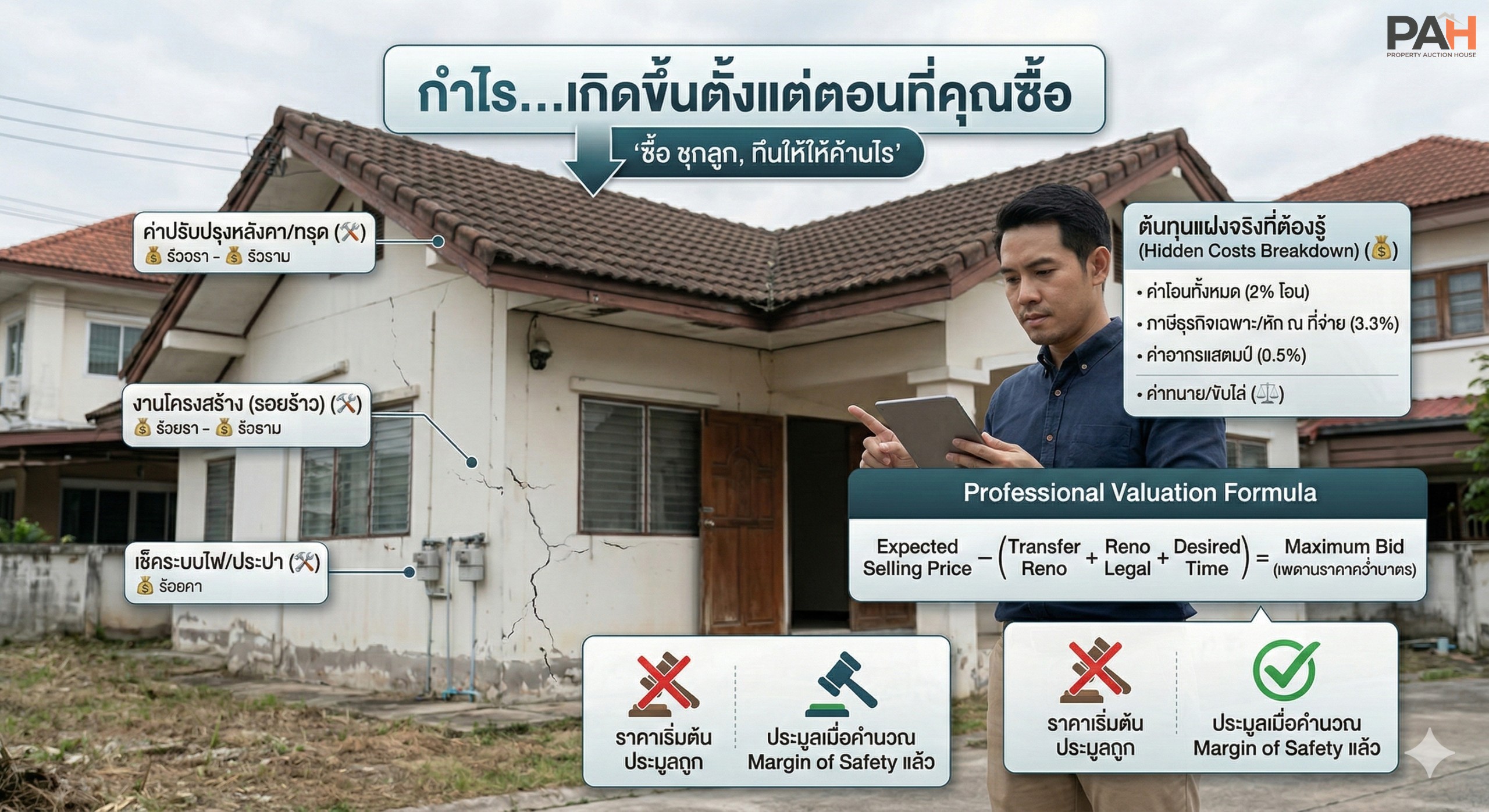
The standard rate is often referenced at 2% (calculated based on Land Department rules/official appraised value used for registration). (Thailand Property Law)
3.2 Mortgage registration fee (Mortgage registration fee) — for financed purchases
The standard rate is often referenced at 1% of the registered mortgage amount. (Thailand Property Law)
3.3 Stamp duty / Specific Business Tax (SBT)
Stamp duty is often referenced at 0.5% (SCB)
Specific Business Tax (SBT) + local tax are often referenced as 3.3% when applicable. (SCB)
Important note: In practice, “seller-side taxes” are often paid by the seller, but this can be negotiated—so you should create a clear “Who pays what” table and attach it to the contract from the start.
3.4 Recommended tool to estimate costs before transfer
For a more official preliminary estimate of fees/taxes, use the Land Department’s LECS system to calculate before the transfer date. (LECS)
4) Don’t Miss It: 0.01% Transfer & Mortgage Registration Fee Measure (Reported Until 30 June 2026)
If your property is eligible, this measure can significantly reduce your transfer-day lump sum, because the rates drop from the standard levels (transfer 2% / mortgage 1%) to 0.01%. (reic.or.th)
Commonly cited eligibility points (simplified)
Must be an eligible residential purchase within a price/amount cap (often cited as not exceeding 7 million THB) (Tilleke & Gibbins)
Requirements may include buyer conditions and registering the mortgage in the same transaction, plus mortgage caps—always follow the effective announcement on the actual transfer date. (Tilleke & Gibbins)
The measure is cited as effective until 30 June 2026. (Tilleke & Gibbins)
Worked example (for illustration)
Assume the registration base value is 3,000,000 THB and the mortgage is 2,700,000 THB:
Standard rates:
Transfer fee 2% = 60,000 + Mortgage registration 1% = 27,000 → Total 87,000 THB (Thailand Property Law)Eligible for 0.01%:
Transfer fee 0.01% = 300 + Mortgage registration 0.01% = 270 → Total 570 THB (Tilleke & Gibbins)
Note: This does not include other seller-related taxes/duties that may apply, and it does not include bank/loan costs.
5) Bank/Loan Costs (Often Forgotten)
Common items (depending on the bank and promotions):
Appraisal fee (some banks waive it; others charge)
Fire insurance (often required as part of the loan package)
Mortgage life insurance (MRTA) depending on preference/package/bank terms
Other loan-specific fees under your individual conditions
Tip: Before applying, request a written summary of transfer-day costs + loan-related costs from the bank to prevent budget surprises.
6) Post-Transfer Money: Budget to “Actually Move In” (Don’t Push It Onto Credit Cards)
After transfer, there are often immediate costs such as:
repairs/renovation/deep cleaning
essential furniture and appliances
prepaid common fees / outstanding common fees (housing estate/condo)
utility meter activation fees/deposits (water/electricity) and internet setup
moving and installation (AC, water heater, curtains, etc.)
emergency fund for unexpected events in the first 3–6 months of repayment
A Shortcut Formula: The Minimum Upfront Cash Plan (So You Don’t Get Stuck)
Think in 4 key buckets:
Reservation/contract money
Down payment + buffer
Transfer-day costs (transfer/mortgage/taxes as agreed) + check eligibility for 0.01% (Tilleke & Gibbins)
Move-in budget + emergency reserve
And use the Land Department LECS system to estimate transfer costs in advance. (LECS)
Pre-Purchase Checklist (Actionable Immediately)
Summarize your total budget on one page: home price + reservation/contract + down payment + transfer-day + move-in
Check eligibility for the 0.01% measure and confirm expiry date/conditions for your expected transfer date (Tilleke & Gibbins)
Request the bank’s written cost summary (appraisal/insurance/loan-side transfer costs)
Create a “Who pays what on transfer day” table and attach it to the contract
Run a quick estimate using LECS (LECS)
Set aside a repair/move-in budget and at least one emergency buffer
FAQ: What Lump-Sum Cash Do You Need to Buy a Home in 2026?
1) How many main cash buckets should I prepare?
Typically 5 buckets: reservation/contract, down payment, transfer-day costs, bank/loan costs, and move-in + reserve.
2) Is the transfer fee calculated from the purchase price or the appraised value?
In practice, Land Office fees typically use the registered/appraised value base per the legal/registration rules. You should confirm the actual numbers before transfer via LECS. (LECS)
3) How long does the 0.01% measure last?
Some sources cite the measure as extended until 30 June 2026, subject to conditions. (Tilleke & Gibbins)
4) If I can get 100% financing, do I still need lump-sum cash?
Yes. You still need reservation/contract payments, transfer-day costs, bank/loan costs, and move-in funds. Also, the final approved amount still depends on the bank’s underwriting, even if policy-level LTV is temporarily relaxed. (Reuters)
5) What’s a fast, structured way to estimate transfer-day costs?
Use the Land Department’s LECS system to estimate fees/taxes/duties before your transfer date. (LECS)