Leasehold vs Freehold: Which Condo Ownership Gives You Full Rights?
Understand the difference before signing: An easy-to-understand guide for new condo buyers and investors.
Summary for readers: If you're dreaming of owning a home or condo but aren't sure whether to choose Leasehold or Freehold, know that the difference between these two terms is more than just price—it’s about "true ownership." This article will give you clear answers, diving deep into every issue to make your decision easier!
1. Why is the distinction between Leasehold and Freehold confusing for the new generation?
In an era where real estate prices continue to rise, buying a condo is no easy task for the new generation. Many people hesitate and have questions when encountering real estate terms like Leasehold and Freehold. In this article, we promise to break down complex legal information into the simplest language possible. Whether you are a first-time buyer looking for your own space, an investor seeking returns, or even a foreigner wanting a residence in Thailand, you will definitely get clear answers.
2. Getting to know: What exactly are Leasehold and Freehold?
Before deciding which is better, let's understand the basic meaning of both terms.
What is Freehold?
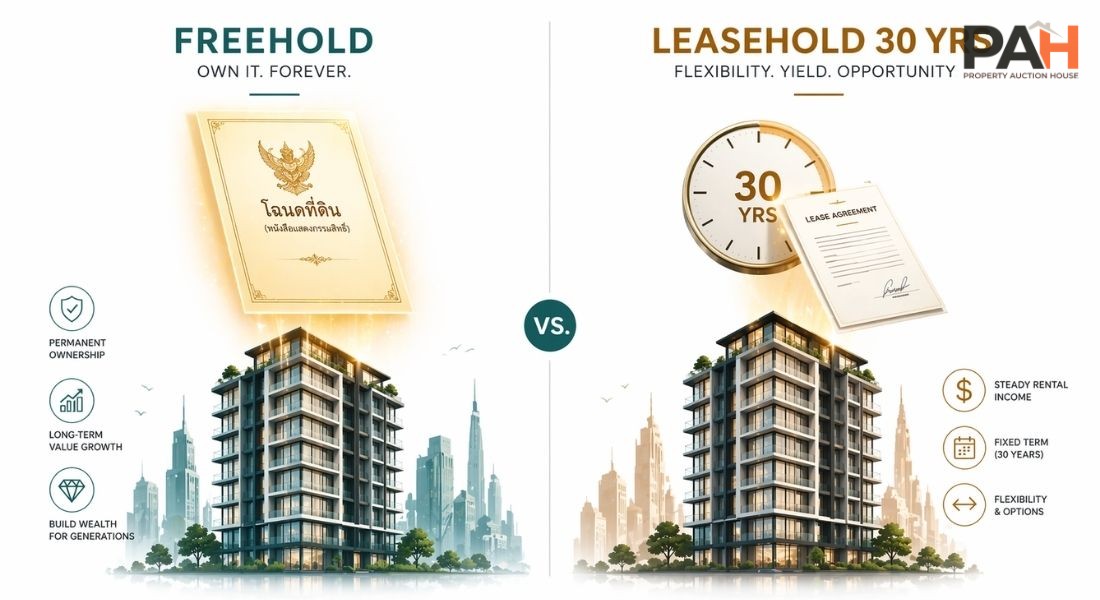
Freehold means full ownership. Simply put, when you pay to buy a condo, you become the "complete owner" of that unit. The title deed (Nor.Sor.2) will list you as the owner. You can buy, sell, transfer, rent out, or even pass it on as an inheritance to your descendants without any expiration date.
What is Leasehold?
Leasehold means long-term rental or leasehold rights. You do not own the land or the building itself, but you have the "right to reside and possess" for the duration specified in the contract. In Thailand, this is typically 30 years and may have conditions for renewal (e.g., 30+30 years). Once the contract expires, the possession rights revert to the actual landowner.
Why do Leasehold condos exist?
Many may wonder why we don't just build Freehold projects. The answer is "land constraints." Especially in prime CBD areas, the land often belongs to the Crown Property Bureau, government agencies, or old families who do not wish to sell the land outright, thus allowing real estate developers to lease it long-term to build projects instead.
3. Comparing Pros & Cons: Leasehold vs Freehold
To give you the clearest picture, let's look at the comparison table of the pros and cons of both formats.
Topic | Freehold | Leasehold |
Pros | - Permanent ownership: It is 100% your asset. - Liquid: High market demand. - Easy bank loans: High loan-to-value ratio (some banks offer up to 100%) - Inheritance: Can be passed on to descendants. | - Affordable: 20-40% cheaper than Freehold in the same location. - Prime location: Often situated in areas where Freehold is no longer available. - Available for foreigners: No quota restrictions like Freehold. |
Cons | - High price: Requires higher initial capital. - Limited location: New, well-located Freehold projects are rare and very expensive. | - Expiration: Must return the property when the contract ends. - Difficult to resell: Value decreases as the remaining lease term shortens. - Harder to get loans: Banks provide lower loans and interest rates may be higher. - Hidden costs: Renewal fees or high transfer fees. |
4. Deep Dive: Why is Leasehold popular among foreigners?
For foreigners who want to own a condo in Thailand, there are relevant laws to understand:
Thai Law and the 49% Quota: According to Thai law, foreigners can hold Freehold condo ownership for a maximum of 49% of the total sellable area of a project (Foreign Quota).
Leasehold is a popular alternative: When the 49% quota is filled, foreigners who still wish to live in that project usually opt for Leasehold because there are no quota restrictions.
Security for foreigners: Although it is just a leasehold right, Thai law explicitly protects long-term lease contracts registered at the Land Department, giving foreigners peace of mind regarding the safety of their possession throughout the contract period.
5. Investor Perspective: Which one fits your portfolio?
If you are an investor, the choice directly affects your strategy and profits. [Insert link: Condos for investment]
Freehold excels in Capital Gain: Suitable for long-term investment because the value of land and Freehold condos tends to appreciate over time. Even if the building is old, land value often increases.
Leasehold wins in Rental Yield: Because the acquisition cost (condo price) is 20-40% lower than Freehold, but it can be rented at market rates, the annual Rental Yield percentage is often significantly higher.
Investment Style Summary: * Prefer long-term appreciation / Asset accumulation -> Choose Freehold
Focus on rental Cash Flow / Quick ROI -> Choose Leasehold
6. Checklist: 5 Questions you must answer before buying!
Before signing the contract, try asking yourself these 5 questions:
What is your purpose? (Living long-term, investing for rent, or passing on as an inheritance?)
What is your budget? (Can you afford the higher Freehold price?)
How much time is left on the Leasehold? (If buying a secondary condo, check how many years are remaining.)
What are the contract renewal conditions? (Is it specified how many times it can be renewed and what the costs are?)
What are your plans in 10-20 years? (You might move countries, move houses, or expand your family.)
7. Conclusion: Which is better?
Ultimately, the debate between Freehold vs Leasehold has no single correct answer for everyone. * Choose Freehold if you want peace of mind, desire true ownership to pass on as an inheritance, and have sufficient budget.
Choose Leasehold if you love the prime city lifestyle, want high rental returns (good Yield), and are not attached to permanent asset ownership.
Our advice: Consider your "life goals" and "budget" primarily. Read every line of the contract carefully, especially if you are looking at a Leasehold project.