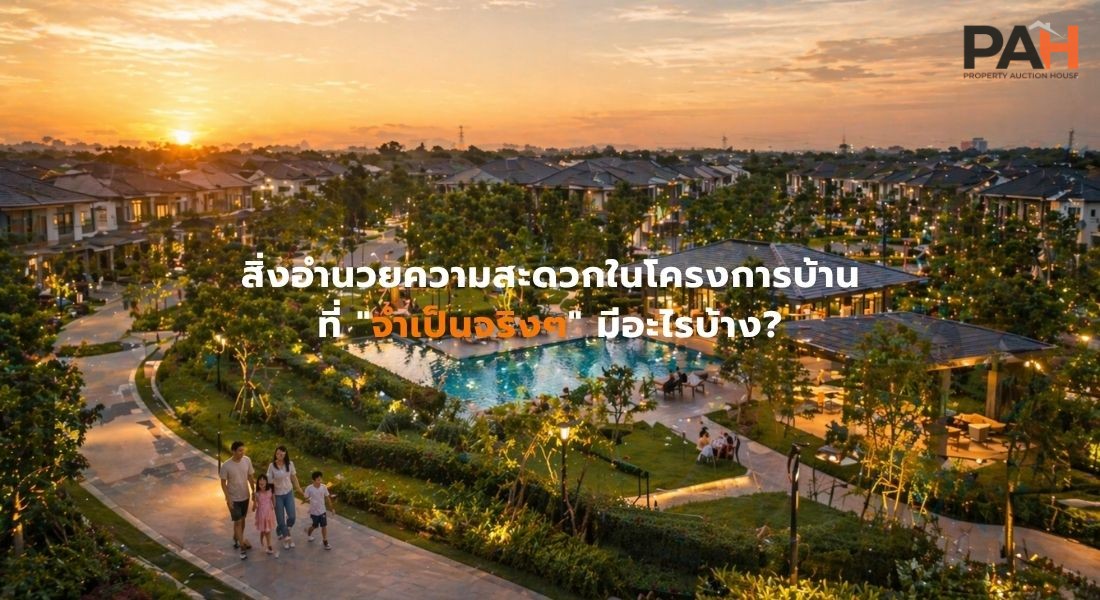
What housing project facilities are truly essential?
A complete checklist before deciding to buy — what are the "must-haves," the "nice-to-haves," and what is "overpriced and unnecessary"?
Updated: April 2025 | Read time: 8 minutes
📌 Quick Answer
Truly essential housing project facilities include 24-hour security, adequate parking, common green spaces, standardized property management, and convenient internal roads. These directly impact your daily quality of life. Other facilities, such as swimming pools or gyms, are considered "nice-to-haves," depending on each family's lifestyle.
What are housing project facilities?
Facilities in a housing project refer to the common areas, systems, and services that the developer provides for all residents to share, ranging from security systems and relaxation areas to community management.
Maintenance costs for these facilities are usually included in the "common area fee" (or CAM fee) that residents must pay monthly or annually. Therefore, the more facilities a project has, the higher the common fee usually is.
Why is choosing facilities important before buying a home?
Because facilities affect your daily life in the long term in at least three ways:
Family safety — A good security system reduces the risk of untoward incidents within the project.
Quality of life — Green spaces, playgrounds, and exercise paths help improve physical and mental health.
Future property value — Homes in projects where facilities are well-maintained usually have higher resale prices than the average.
What facilities are truly necessary?
1. Security system — The indispensable item
The security system is the number one facility every project must have, as it directly impacts the safety of life and property.
A good security system should consist of:
24-hour security guards.
CCTV cameras covering all high-risk points, such as entrances/exits, parking areas, and walkways.
Access control systems, such as Key Cards, Intercoms, or Smart Gates.
A guard house with a visitor log system.
Lighting along the project's internal paths throughout the night.
💡 Questions to ask the project: Is the security company licensed? How many shifts are the guards rotated per day?
2. Parking — A facility often overlooked
Insufficient parking is one of the most common complaints in housing communities.
Things to check regarding parking:
Parking-to-unit ratio (the standard should be at least 2 cars per house).
Is there enough guest parking?
Are internal roads wide enough for cars to pass each other conveniently?
Are there drop-off/pick-up points for delivery services and ride-hailing cars?
3. Green spaces and common parks — The lungs of the community
Green space is not just for aesthetics; it directly affects the mental health of residents. Research from many countries shows that living near green spaces helps reduce stress and increases daily happiness.
Good green spaces should have:
A well-maintained common garden.
Shade trees along walkways.
A playground with safe, standardized equipment.
Outdoor activity areas for community events.
4. Property Management (Juristic Person) — The heart of the project often forgotten
A strong juristic person (homeowner association management) is the difference between a project that is "good to live in" and one that "deteriorates quickly."
A good juristic management should have these qualifications:
Holds a valid business license.
Has a clear maintenance plan for common areas.
Has a responsive repair request system.
Holds regular homeowner meetings.
Maintains transparency in managing the common fund.
⚠️ Things to ask before buying: What is the current common fee per square meter? Is there a reserve fund for maintenance?
5. Roads and internal pathways — A facility used daily
The condition of roads and paths within the project affects daily life more than many realize.
Standards that should be met:
Internal roads should be at least 8 meters wide.
Sidewalks should be clearly separated from car lanes.
Good drainage system, no flooding after rain.
Sufficient lighting along the entire road.
What are "nice-to-have" facilities based on lifestyle?
These facilities are not necessary for everyone, but if they match your lifestyle, they can significantly increase your quality of life.
Swimming Pool
Suitable for: Families with children or those who exercise by swimming regularly.
Before deciding to prioritize this, ask:
Is the pool size sufficient for the number of houses in the project?
Is the water quality checked regularly?
What are the opening and closing hours?
Are there additional costs, or is it included in the common fee?
Fitness / Gym
Suitable for: People who exercise regularly and want to save on external gym membership fees.
Things to look at carefully:
The number and quality of exercise equipment.
Is the space wide enough to accommodate multiple users at the same time?
Is there good ventilation or air conditioning?
Sports Fields
Suitable for: Families who enjoy sports or projects with an active community.
Common field types include badminton courts, tennis courts, and basketball courts.
Clubhouse / Community Hall
Suitable for: People who need space for parties, meetings, or community activities.
Ask clearly: Is booking free or is there a fee? How many people can it accommodate? Is there a kitchen or catering equipment available?
Which facilities "look good but may not be worth it"?
Some facilities are used as selling points by developers, but in reality, they might not be used and actually increase the burden of common area fees.
Examples of facilities to consider carefully:
Rooftop Garden — If it is a low-rise project that already has a garden, going up to the roof might not be convenient in real life.
Complex Smart Home Systems — Systems that look fancy but are difficult to repair and have high maintenance costs.
Shops in the project — If the project is already near a mall or convenience store, shops within the project might not last long.
Co-Working Space — Useful only for projects where most residents actually work from home.
Facility checklist before buying a house — use it to ask the project
Copy this list to use when visiting the project.
Group ✅ Must-have — If not present, reconsider
24-hour security guards
CCTV covering all points
Access control (Key Card / Gate)
Sufficient parking per unit
Roads and pathways in good condition
Drainage system, no flooding
Common green space
Standardized property management
Group 🔵 Nice-to-have — Depends on preference
Swimming pool
Fitness / Gym
Sports fields
Clubhouse / Event room
Jogging track
Playground (Important if you have children)
Group ❓ Ask clearly before deciding
How much is the monthly common fee?
Which facilities are included in the common fee?
Are there additional fees for the pool/gym?
Is there a reserve fund for maintenance?
Which company manages the juristic office?
Frequently Asked Questions (FAQ)
Q: How are facilities in housing projects different from condos?
A: Housing projects usually focus on horizontal facilities like parks, roads, and open spaces, while condos usually have more compact vertical facilities like rooftop pools and lobby areas. Condo common fees are usually higher than housing projects because they also have to manage high-rise building systems.
Q: What is the average common fee for a housing project?
A: Common fees for housing projects in Thailand generally range from 30–80 Baht per square wah per year, depending on the project level and available facilities. Luxury projects with swimming pools and gyms may be up to 100 Baht or more per square wah per year.
Q: If the project is not yet finished, how do I know if the facilities will be as advertised?
A: You should check these 3 things: (1) Check other projects by the same developer to see if they have a history of fulfilling promises, (2) Ask to see blueprints and details of the facilities in the sales contract, and (3) Read reviews from residents of other projects by the same developer.
Q: Do good facilities affect the resale price of a house?
A: Yes, generally, houses in projects with complete, well-maintained facilities have higher resale prices (about 10–20% higher) than projects with dilapidated facilities and also sell faster.
Q: What does the common fee cover?
A: Generally, the common fee covers the salaries of the juristic team and security guards, electricity and water for common areas, gardening and cleaning costs, maintenance of common equipment, and common area insurance.
Summary: Good facilities are not about "having a lot," but about "being usable and well-maintained"
Choosing a housing project with appropriate facilities is not about ticking all the boxes, but about choosing facilities that align with your family's lifestyle and ensuring that the juristic office will maintain them in the long run.
Before deciding to buy, we recommend these 3 steps:
Visit the actual project on a weekday — to see the actual state of use, not just when the project is hosting an event.
Talk to current residents or read online reviews — to find out if the advertised facilities match reality.
Ask for details of the common fees and reserve funds — to assess long-term financial burdens.
This article was prepared to provide preliminary information to those considering buying a home. If you need specific advice, we recommend consulting a real estate expert directly.