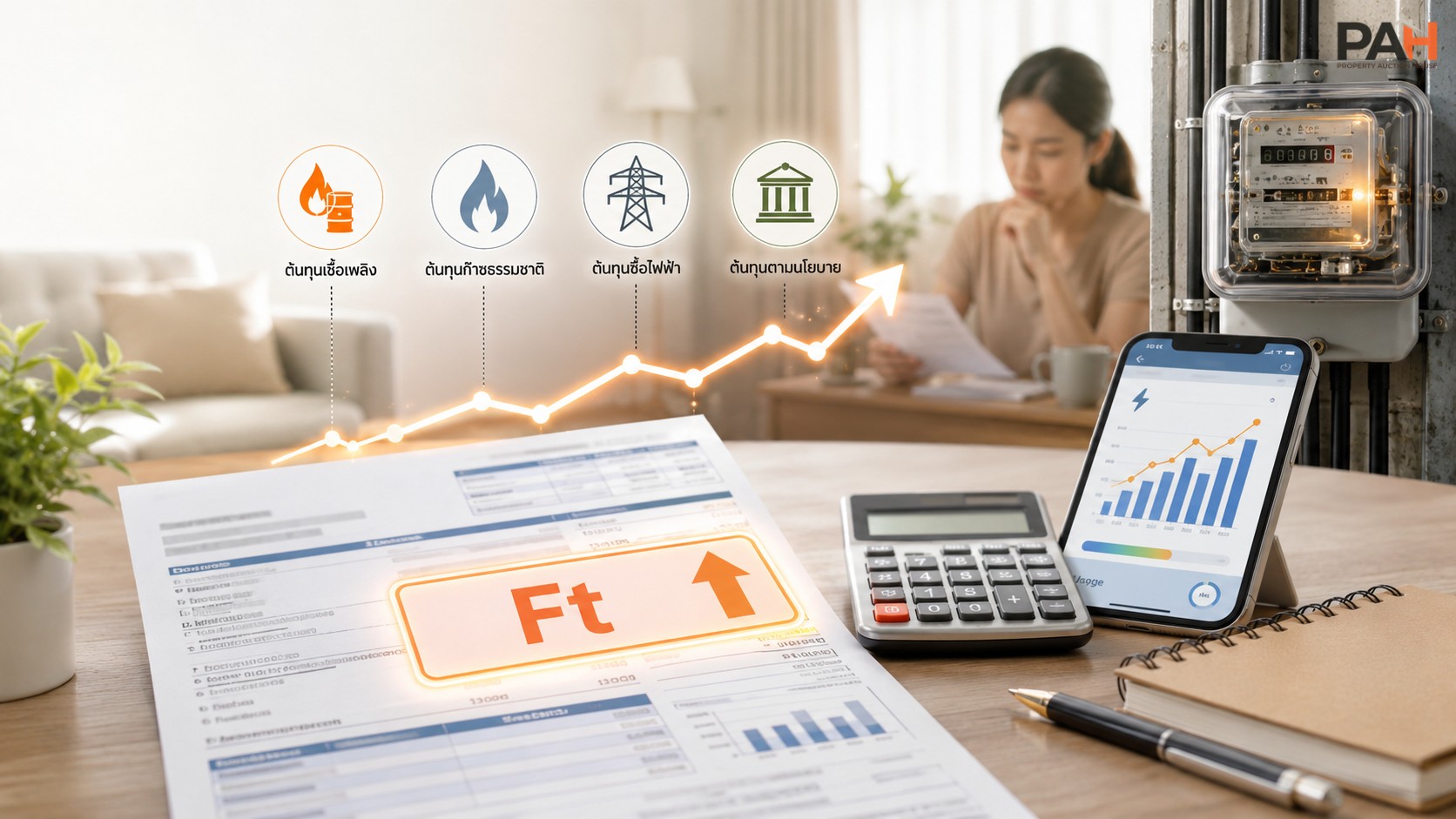
Understanding the Ft Tariff: The Culprit Behind High Electricity Bills, Plus Calculation Formulas and Key Factors You Need to Know
Have you ever wondered, “I used about the same amount of electricity as last month, so why is my bill higher?” Many people might assume it's because they ran the air conditioner longer or their appliances are consuming more energy. In reality, there is another key variable in your electricity bill that can cause fluctuations: the Ft tariff or Fuel Adjustment Charge.
The Ft tariff is not a fine or a hidden service fee. It is part of the electricity tariff structure designed to reflect electricity production costs that change according to energy conditions. The Provincial Electricity Authority (PEA) explains that the electricity bill charged to users consists of three parts: the Base Tariff, the Ft tariff, and Value Added Tax (VAT).
What is the Ft Tariff?
Ft stands for Fuel Adjustment Charge, which is a variable electricity rate that adjusts up or down based on costs beyond the control of the utility provider, such as fuel prices, electricity procurement costs, and government policy expenses.
Simply put, the Ft tariff is like an “energy cost differential” compared to the base electricity rate. If the cost of electricity production rises, the Ft tariff is likely to increase. If costs decrease, the Ft tariff may also drop.
The Ft tariff is reviewed every 4 months under the supervision of the Energy Regulatory Commission (ERC).
What is the Current Ft Tariff?
For the period of May – August 2026, the Provincial Electricity Authority has announced the Ft tariff at 0.1623 Baht per unit or 16.23 Satang per unit.
This means that if your household uses 300 units of electricity, the Ft portion alone will be:
300 x 0.1623 = 48.69 Baht
This figure does not yet include the base tariff and VAT. Therefore, while the Ft tariff might seem small per unit, when combined with the actual electricity usage—especially in homes running air conditioners for many hours or businesses with high consumption—the Ft tariff can significantly add to your electricity burden.
How to Calculate the Ft Tariff on Your Bill
A simple calculation formula for general users is:
Ft to pay = Number of units used x Ft rate per unit
Example:
If you use 450 units and the Ft rate is 0.1623 Baht per unit:
450 x 0.1623 = 73.04 Baht
Therefore, your electricity bill for that month will include approximately 73.04 Baht in Ft charges before adding VAT and other components.
Simple Formula for Total Electricity Bill
In general, the total electricity bill can be broken down as follows:
Total Bill = Base Tariff + Ft Tariff + VAT
Or, to be more specific:
Estimated Total Bill = (Usage per unit x rate) + Monthly Service Fee + Ft Tariff + VAT
Simple Example:
Suppose you use 300 units.
Ft tariff for May – Aug 2026 = 0.1623 Baht per unit.
Ft charge = 300 x 0.1623
Ft charge = 48.69 Baht
If the household usage increases to 800 units:
Ft charge = 800 x 0.1623
Ft charge = 129.84 Baht
As you can see, the more electricity you use, the higher the total Ft charge becomes, even if the rate per unit remains the same.
The Official Retail Ft Formula
Structurally, the retail Ft is calculated using the following formula:
Retail Ft = (FAC + AF) / EU
According to the Energy Policy and Planning Office (EPPO):
FAC is the estimated cost of fuel, electricity purchases, and government policy expenses.
AF is the cumulative balance from previous periods, resulting from the difference between the collected Ft and the actual incurred costs.
EU is the projected retail unit sales for the utility and direct customers.
This formula reflects that the Ft tariff is not caused by fuel prices alone but also includes historical cumulative differences and projected electricity sales volume for that period.
Why Does the Ft Tariff Make Electricity Bills Expensive?
The main reason is that the Ft tariff changes according to the actual costs of the electricity system. When energy-related factors rise, the Ft tariff is likely to increase as well. The key factors include:
1. Fuel Prices for Power Generation
Thailand still relies heavily on natural gas to produce electricity. When global market prices for natural gas or energy rise, production costs increase accordingly.
2. Costs of Electricity Purchases
The power system is not produced solely by the utility provider; it is also purchased from private power producers and neighboring countries. If these procurement costs rise, it impacts the Ft tariff.
3. Exchange Rates
Many types of fuel are priced based on international markets. If the Thai Baht weakens, the cost of importing fuel may rise, which in turn affects the Ft tariff.
4. Government Policy Expenses
At times, the government may implement measures to reduce electricity bills, freeze prices, or manage cost burdens. This may cause the Ft tariff paid by citizens to be lower than actual costs for that period, but the resulting difference might be accounted for in subsequent periods.
5. Cumulative Balance from Previous Periods
If the previous period’s actual costs were higher than the amount collected, the future Ft tariff might need to reflect that difference, meaning your bill rises not just due to current costs but also past cumulative burdens.
Can the Ft Tariff Be Negative?
Yes, the Ft tariff can be both positive and negative. If the actual cost is higher than the base tariff, the Ft is usually positive, increasing the bill. If costs are lower than expected, the Ft can be negative, which helps reduce the bill.
ERC statistics show that the Ft tariff has had both negative and positive periods. For example, January – April 2026 was at 9.72 Satang per unit, whereas in certain periods like 2020–2021, it was negative.
How Does the Ft Tariff Differ from the Base Tariff?
The Base Tariff is the primary electricity rate calculated based on long-term cost structures, such as power plants, transmission systems, distribution systems, base fuel costs, and operating expenses.
The Ft Tariff is the portion of the electricity bill that adjusts according to variable costs at any given time, such as rapidly changing fuel prices or subsequent government policy expenses.
In short:
Base Tariff = Long-term core costs
Ft Tariff = Variable costs adjusted every 4 months
How to Reduce Electricity Bills When Facing a High Ft Tariff
Even though consumers cannot control the Ft rate directly, they can reduce its impact by lowering the total number of units consumed. Since the Ft charge is applied based on the number of units, using less electricity naturally lowers the total Ft amount paid.
Practical tips include:
Set the air conditioner to 26–27 degrees Celsius and clean the air filters regularly.
Turn off unused appliances and avoid standby modes.
Replace old light bulbs with LEDs.
Do laundry or ironing in consolidated batches rather than small, scattered loads.
Choose energy-efficient (Label No. 5) appliances that are the right size for your needs.
Monitor your air conditioner usage habits, as it is often the largest power consumer in the home.
If consumption is very high, consider installing solar panels or home energy management systems.
Conclusion: The Ft Tariff Is a Small Part of Your Bill, But It Affects Your Pocket
The Ft tariff is a variable electricity charge that reflects energy costs, electricity procurement, and government policy expenses, adjusted every 4 months. While users cannot directly control the Ft rate, they can control the “number of units consumed.”
Therefore, if you want to lower your electricity bill when the Ft tariff is high, the key is not just to monitor whether the Ft has gone up or down, but to start by checking your household electricity usage behavior—especially regarding air conditioners, refrigerators, water heaters, and appliances that run for long periods—because every extra unit consumed means more Ft charges to pay.