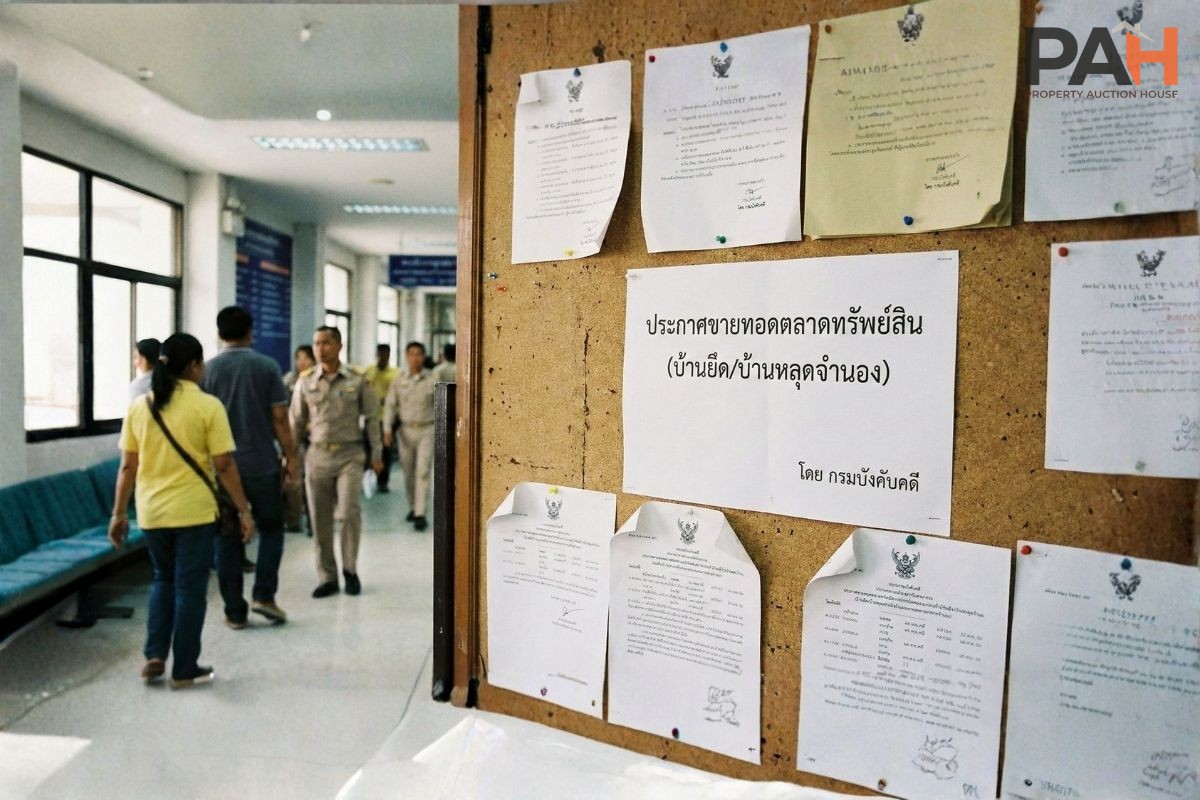
Repossessed House, Court-Enforced Property & Foreclosed Home in Thailand
Complete Government Auction House Buying Guide (Updated)
Repossessed houses, court-enforced properties, and foreclosed homes are among the most searched keywords by buyers looking for cheap houses in Thailand. Although these terms are often used interchangeably, they represent different legal stages under Thai law.
This guide explains the differences between repossessed houses, court-enforced houses, and foreclosed homes, and provides a complete overview of buying auction houses from the Legal Execution Department, including auction announcements, deposits, bidding, property inspection, and ownership transfer—all in one place.
What Is a Repossessed House in Thailand?
Repossessed houses are properties seized under a court order after the owner defaults on debt repayment and the creditor proceeds with legal enforcement.
A repossessed house is not always auctioned immediately
Once officially listed for auction, it becomes a court-enforced property
SEO Keywords Covered
Repossessed house Thailand
Bank repossessed house
Buy repossessed house Thailand
Cheap repossessed property
What Is a Court-Enforced Property?
A court-enforced property is a repossessed house that has entered the official public auction process conducted by a government authority to satisfy a court judgment.
Key characteristics:
Open and transparent auction process
Highest bidder wins
Sold strictly as-is, with no warranty
SEO Keywords Covered
Court enforced property Thailand
Property auction Thailand
Buy court auction house
Legal Execution Department house auction
What Is a Foreclosed House in Thailand?
A foreclosed house is a mortgaged property that the owner failed to redeem, allowing the bank or creditor to sell it.
Foreclosed houses may be:
Sold directly by banks, or
Sold through government auction as a court-enforced property
SEO Keywords Covered
Foreclosed house Thailand
Buy foreclosed property Thailand
Cheap foreclosed house
Bank foreclosed homes
How to Read a Thailand Auction Announcement Correctly
Mortgaged Property / Legal Encumbrances
The house is still subject to mortgage or legal rights.
The winning bidder may need to clear the encumbrance independently.
Withdrawal of Seizure
The property has been removed from legal enforcement and will not be auctioned.
Auction Suspended
The sale is temporarily suspended and may be re-listed in future auctions.
No Bidder
No bids were placed.
The next auction round usually offers a lower reserve price.
Auction Deposit & Bidding Process for Court-Enforced Houses
Deposit typically 10–20% of the appraised value
Unsuccessful bidders receive a refund
Winning bidder who fails to pay → deposit forfeited
Bidding Steps
Bidder registration
Deposit payment
Competitive bidding
Hammer fall (sale confirmation)
Property Inspection: Repossessed & Foreclosed Houses
Interior inspection is usually not allowed
Properties may be occupied or contain belongings
Buyers are responsible for all post-transfer actions
Payment & Ownership Transfer
Balance payment within the specified deadline
Ownership transfer at the Land Office
Buyer pays all transfer fees, taxes, and duties
FAQ
What is the difference between a repossessed house and a court-enforced house?
A repossessed house has been seized, while a court-enforced house has already entered the auction process.
Are all foreclosed houses sold by auction?
No. Some are sold directly by banks.
Are court-enforced houses really cheaper?
Often yes, but buyers must consider renovation and legal risks.
What if the repossessed house is occupied?
The buyer must handle eviction or negotiation legally.