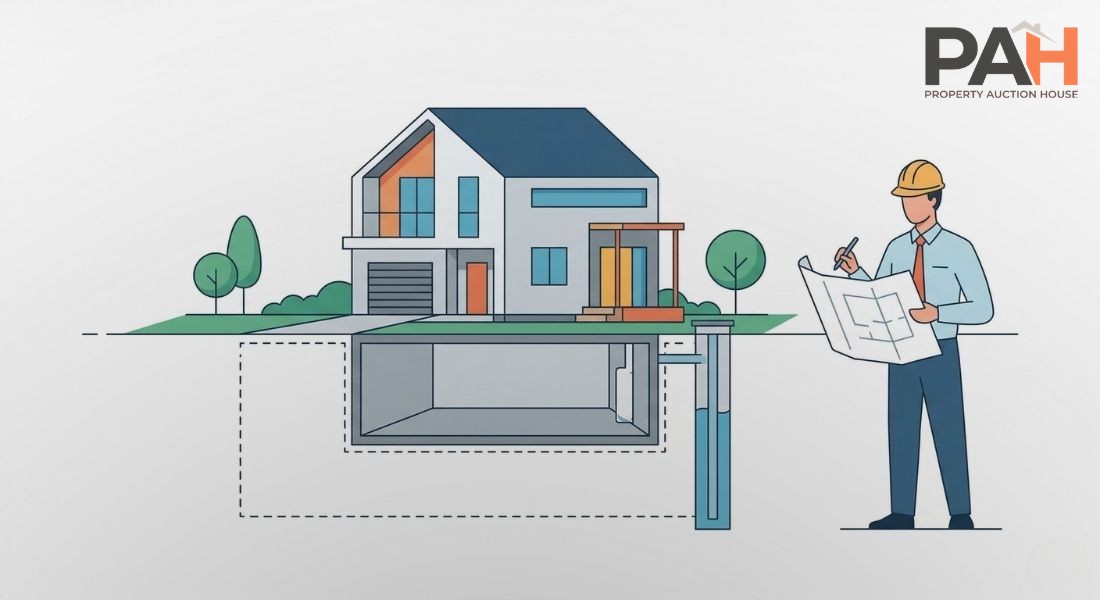
How Deep Do Your Land Rights Go? Understanding Underground Rights and Excavation Laws Every Homeowner Should Know
When we buy or own a piece of land, we usually focus on utilizing the "surface" area. But a common question that often sparks debate in construction is: "How deep do our land rights actually go?" Can we dig tunnels, drill for groundwater, or use the underground space 100% as we please?
This article will explore the legal answers so you can exercise your land rights correctly, safely, and without the risk of being sued by your neighbors.
Legal Land Rights: Do We Really Own the Underground?
In Thailand, the law clearly recognizes underground rights, based on Section 1335 of the Civil and Commercial Code, which states:
"The extent of land ownership extends above and below the surface."
This means that, in theory, you own the land deep into the ground. However, in practice, this right does not grant you unlimited power to do whatever you want, as underground utilization is strictly controlled and reserved by other specific laws.
3 Legal Restrictions Landowners Must Know Before Digging
Even though you have ownership rights below the surface, there are 3 major exceptions where you cannot act arbitrarily:
Underground resources belong to the nation (Minerals Act and Petroleum Act): If your underground area contains valuable minerals like gold or tin, or oil and natural gas, these are considered national assets. You cannot dig them up to sell yourself. To do so requires a government concession.
No arbitrary groundwater pumping (Groundwater Act): You cannot immediately drill and pump groundwater under your land for personal use. You must always obtain permission from the Department of Groundwater Resources first to prevent the depletion of groundwater levels, which can lead to widespread land subsidence.
Underground expropriation (MRTA Act): This is a common occurrence in Bangkok. When the government needs to build an underground railway (MRT) passing under your land, they have the legal authority to expropriate or register an underground servitude. Compensation is paid based on the depth—the deeper the tunnel and the less it affects the surface, the lower the compensation. However, you retain ownership of the surface and can build normally (subject to engineering limitations).
Excavation and Land Filling Laws: How Deep Can You Dig Before Needing Permission?
Aside from understanding your rights, the most crucial aspect of underground excavation is "safety" to prevent landslides or cave-ins that could cause severe damage. Therefore, Thailand regulates this through the Excavation and Land Filling Act, B.E. 2543 (2000), which outlines 2 main scenarios:
Scenario 1: Excavating "Deeper" than 3 Meters (or if the pit opening exceeds 10,000 sq.m. / approx. 6 rai 1 ngan)
You must notify the local authorities (such as the district office or municipality) before starting.
You must submit blueprints, layouts, and excavation methods.
You must provide an "erosion protection system plan" (e.g., retaining walls, sheet piles) certified for safety by a licensed engineer.
Scenario 2: Excavating "Less" than 3 Meters
Generally, no notification to local authorities is required.
Crucial Exception: If you excavate near a neighbor's fence or property line at a distance less than twice the depth of the pit, the law strictly requires you to install an erosion protection system for your neighbor. If you neglect this and cause a landslide or their wall to collapse, you will be fully liable for all damages.
Conclusion: How Deep Can We Actually Dig?
To summarize simply, directly, and safely, the answer is that you can dig as deep as these two conditions allow:
As deep as it doesn't violate the law: You must not infringe on others' rights, cause a nuisance, or endanger your neighbors' lives or property.
As deep as your budget and engineering permit: If you have the budget for construction and an engineer can design a robust protection system to prevent surrounding damage, you are good to go.
Always remember: "We have rights to our land, but those rights must not violate others." If you want to dig deep to build a basement or a swimming pool, you should always consult engineers and experts first.
(Compiled from information by: Architect ignite)