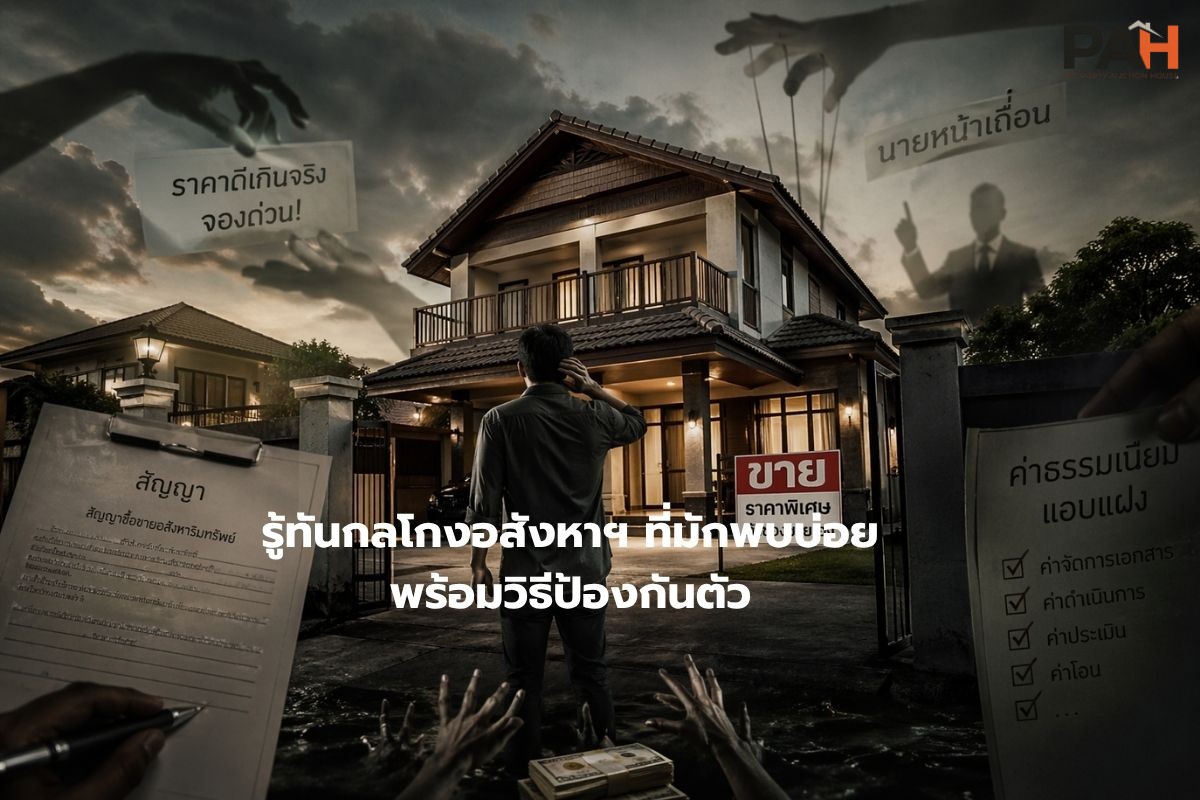
Recognize Common Real Estate Scams and How to Protect Yourself
8 most common real estate scam tactics, along with a checklist to verify before signing contracts or transferring money.
Executive Summary: The most common real estate scams in Thailand include fake title deeds, unlicensed brokers, trap clauses in purchase agreements, deposit fraud, phantom pre-construction projects, double selling, social media fraud, and unregistered long-term leases. The best prevention method is to always verify the title deed at the Land Office and never transfer money before fully verifying all documentation.
What are real estate scams, and how serious are they?
Direct Answer: Real estate scams are fraudulent activities related to the buying, selling, leasing, or investing in land, houses, condominiums, or other properties with malicious intent.
In Thailand, thousands of real estate fraud cases are reported to the Office of the Consumer Protection Board (OCPB) annually. Damages typically range from 50,000 THB to tens of millions of THB, depending on the scheme, and more than half of the victims never recover their money.
Key relevant laws include the Civil and Commercial Code (CCC), Sections 341–348 regarding fraud, the Criminal Code, Section 341 regarding fraud offenses, and the Condominium Act B.E. 2522 (1979) which protects condominium buyers.
8 Most Common Real Estate Scams in Thailand
Scam #1: Fake Title Deeds and Fraudulent Ownership Documents
Direct Answer: A fake title deed is an ownership document not issued by the Land Office. Scammers may forge the entire deed or alter specific details such as the owner's name, land size, or deed number.
Red Flags: Deeds with erasure marks, scratches, or inconsistent typing; the landowner rushing you to sign and transfer money without allowing time for verification; land prices abnormally lower than market rates by more than 30%.
Prevention: Verify the deed yourself at the provincial or district Land Office by requesting a "land data verification" service, where officials will compare it against the official Land Office database. Currently, you can also perform preliminary checks via the Department of Lands' "LandsMaps" application.
Scam #2: Unlicensed Real Estate Brokers
Direct Answer: In Thailand, legitimate real estate brokers must be registered with the Thai Real Estate Broker Association (TREA) or possess a license in accordance with the Real Estate Brokerage Business Act B.E. 2543 (2000).
Unlicensed brokers often use tactics to build trust via social media, showing beautiful property photos, offering unrealistically low prices, and collecting deposits before letting you view the actual property, after which they disappear with the money.
Red Flags: No physical office, contacting only via LINE or Facebook, rushing you to transfer a deposit "because there is another interested party," and inability to present a broker license.
Prevention: Check the registered broker list on the Thai Real Estate Broker Association website (trea.or.th) and use only brokers affiliated with properly registered companies.
Scam #3: Purchase Agreements with Trap Clauses
Direct Answer: Unfair purchase agreements are contracts drafted to unfairly favor the seller, particularly regarding deposit forfeiture conditions and overly broad exclusions.
Common trap clauses include: clauses stating the seller "reserves the right to change project details without prior notice," requirements for the buyer to transfer the property within 7 days regardless of loan status, and clauses stating the seller can forfeit the entire deposit regardless of the circumstances of contract cancellation.
Red Flags: Very long contracts with little room to add terms, lack of protection clauses for the buyer if a loan is denied, and no clear delivery date.
Prevention: Read every line before signing. Hire a lawyer to review the contract, especially for properties valued over 2 million THB. Lawyer fees for contract review are typically 3,000–10,000 THB, which is far less than potential losses.
Scam #4: Deposit Fraud
Direct Answer: This type of fraud involves someone pretending to be the owner or agent, collecting a deposit or booking fee from the buyer, and disappearing before the actual contract date. This is common in online sales and short-term rentals.
In 2022–2023, the Royal Thai Police reported that online real estate fraud cases increased by over 40% from the previous year, with individual victims losing an average of 85,000–300,000 THB.
Red Flags: Property advertised at more than 25% below market price, inability to schedule a viewing by claiming "there is a current tenant," and collecting deposits via personal bank accounts instead of company accounts.
Prevention: Do not transfer any money before meeting the actual owner and verifying their identity along with the deed, use a contract with signed witnesses, and only transfer money once the contract is signed.
Scam #5: Phantom Pre-construction Projects
Direct Answer: Phantom projects are developments that accept booking and deposit money but have no actual construction or stop after the initial phase. The developer lacks proper construction permits or land subdivision licenses.
Legitimate condominium projects in Thailand must obtain a land subdivision license from the Land Office, an EIA (Environmental Impact Assessment) where applicable, and must provide construction insurance according to the Land Allocation Act B.E. 2543 (2000).
Red Flags: Inability to show a land subdivision license number, sales office located outside the project area without reason, only renderings available with no real construction progress photos, and prices more than 20% lower than nearby projects.
Prevention: Verify the land subdivision license at the Land Office, check the construction permit at the local District Office or Subdistrict Administrative Organization (SAO), and ensure the project is in the legal "escrow account" system.
Scam #6: Double Selling
Direct Answer: Double selling is when a seller enters into purchase agreements for the same property with multiple buyers simultaneously, usually collecting deposits from all of them and either transferring ownership to only one or to none at all.
According to Thai law, ownership of land can only be transferred at the Land Office (CCC, Section 458). Therefore, having a purchase agreement does not mean you have acquired ownership.
Red Flags: Owner is unusually rushed, asks for money transfer and contract signing within 24–48 hours, refuses to allow time to verify the deed at the Land Office, or claims a property is "clean" when it actually has debt (mortgage) encumbrances.
Prevention: Check for "encumbrances" on the title deed at the Land Office before every contract signing and schedule the ownership transfer and payment at the Land Office on the same day—do not separate these steps.
Scam #7: Unregistered Long-term Leases
Direct Answer: Real estate lease agreements exceeding 3 years must be registered at the Land Office according to the CCC, Section 538; otherwise, the contract is enforceable for only 3 years, even if it states 10 or 30 years.
This type of fraud is often found in commercial rentals, such as restaurants, small hotels, or agricultural land leases, where the tenant pays a large lump sum in advance, but cannot enforce the contract when they need to prove their rights.
Prevention: Any lease agreement exceeding 3 years must be registered at the Land Office. The registration fee is 1% of the total contract value, which is a worthwhile cost compared to the risks.
Scam #8: Real Estate Investment Fraud via Social Media
Direct Answer: This involves soliciting investments in fake real estate funds or joint venture projects by claiming high returns of 15–30% per year, significantly higher than actual REITs, which offer average returns of 5–8% per year.
Key characteristics of this scam include creating credible-looking Facebook Pages or YouTube Channels, using real property photos from other companies, claiming endorsements from non-existent organizations, and paying returns initially to build trust (Ponzi Scheme).
Prevention: Verify that the company or fund is licensed by the SEC (Securities and Exchange Commission) at sec.or.th, and do not invest in things you do not clearly understand.
How to Verify Before Buying: 10-Point Checklist
This checklist applies to buying land, houses, and all types of condominiums.
Verify the deed at the Land Office — Take the deed number and owner's name to check against the actual database at the Land Office. Cost: 30–50 THB.
Check for encumbrances — Ask the Land Office official if the property has a mortgage, seizure, or other obligations.
Verify the seller's identity — Compare the ID card with the name on the deed. If it is a legal entity, request a company registration certificate from the Department of Business Development.
Verify broker license — If using a broker, ask to see their real estate broker license.
Check construction and subdivision permits — For new projects, ask to see the permit number before booking.
Read every clause in the contract — Do not sign a contract you don't understand. Ask for at least 24 hours to read it.
Consult a lawyer — For properties valued over 1.5 million THB, invest in hiring a lawyer to review the contract.
Pay and transfer simultaneously at the Land Office — Do not transfer money before the official ownership transfer day.
Check outstanding debts — For condos, request a certificate from the juristic person stating there are no outstanding common area fee debts.
Record every conversation — Keep evidence of all communications, including LINE chats, emails, and documents.
What to do immediately if you've been scammed?
Step 1 — File a police report immediately: Go to the local police station where the incident occurred or report to the Cyber Crime Investigation Bureau (CCIB) via hotline 1441 for online cases.
Step 2 — Gather evidence: Keep the contract, money transfer slips, the perpetrator's ID card, communication history, and all relevant photos.
Step 3 — File a complaint with the OCPB: Call the Office of the Consumer Protection Board (OCPB) at 1166 or visit their website at ocpb.go.th.
Step 4 — Consult a lawyer: File a civil lawsuit to recover funds alongside the criminal case. Fraud cases have a 5-year statute of limitations from the date the loss is discovered.
Frequently Asked Questions (FAQ)
Q: Can I check a title deed online? A: A preliminary check can be done via the Department of Lands' "LandsMaps" application, but for official verification, including checking encumbrances, you must visit the Land Office in person.
Q: What is an appropriate deposit amount? A: Generally, the deposit for land and houses is 5–10% of the sale price. If you are asked for a deposit higher than 20% without a clear reason, be cautious.
Q: What should a good purchase agreement include? A: A good contract should specify property details, price, payment schedule, ownership transfer date, fair cancellation conditions for both parties, and penalties for breach of contract.
Q: What should I be aware of when buying a condo from a foreigner? A: You must verify if the room is within the project's "foreign quota," as the law stipulates that foreigners can own no more than 49% of the total sellable area in a project.
Q: Is it safe to buy via online platforms? A: Platforms only act as intermediaries and do not guarantee the accuracy of listings. Buyers must always verify documents and the seller's identity themselves, regardless of where they found the listing.
Summary
There are 8 main types of real estate scams in Thailand: fake deeds, rogue brokers, trap contracts, deposit fraud, phantom projects, double selling, long-term lease scams, and investment fraud. The heart of prevention is: Always verify before transferring money, no matter how rushed you are.
The Golden Rule to remember: Good properties and honest sellers do not need to rush—hurry is the first sign of a scam.