What is "Blind Land" (Landlocked Land)? Can You Buy It? And How to Legally Solve Access Issues (2026 Update)
What is "Blind Land"?
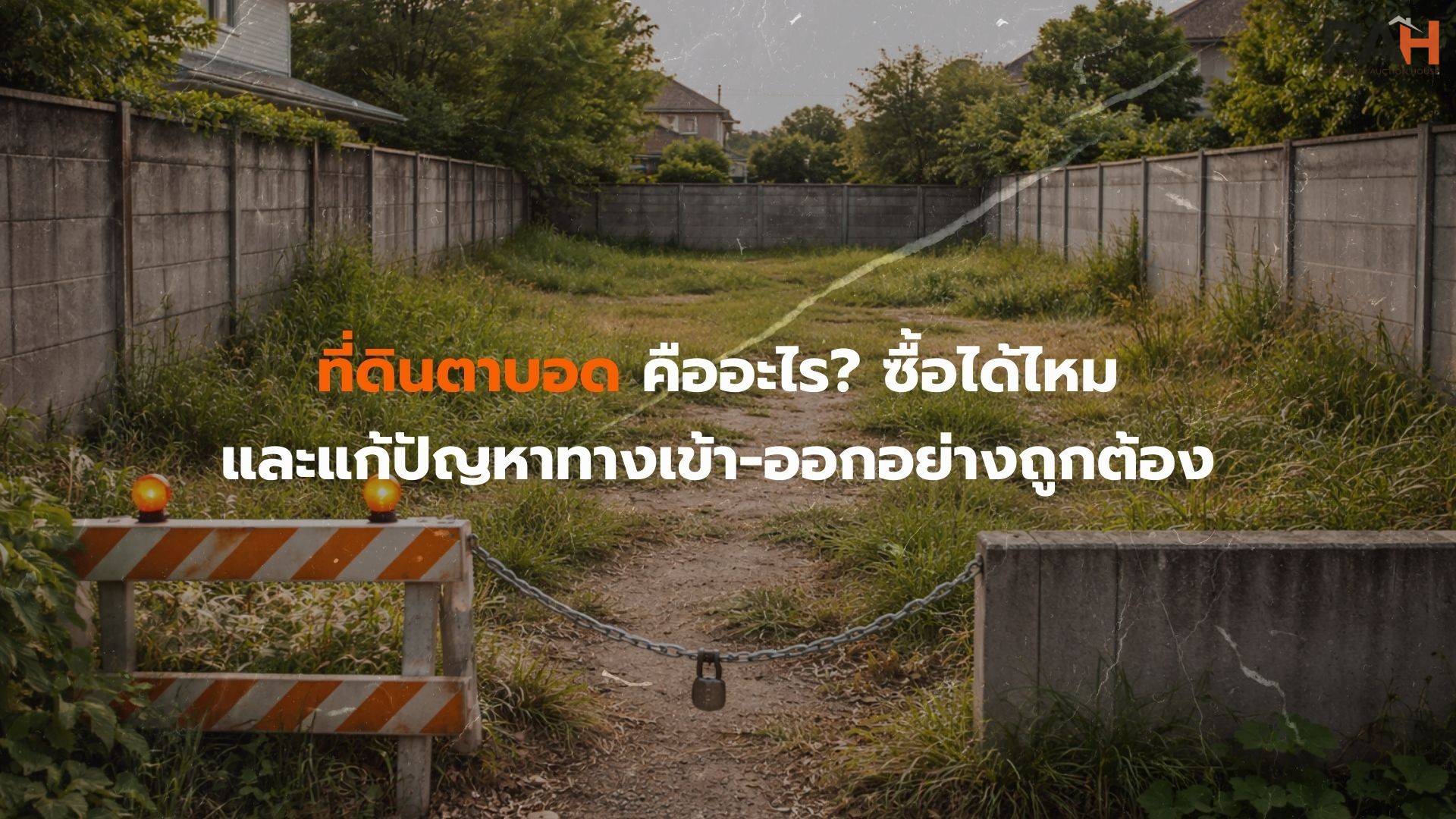
"Blind Land" (Landlocked Land) refers to a plot of land that cannot access a "Public Road" legally.
Many plots "appear to have access" because people have walked or driven through a neighbor's land for years. However, if there are no rights recorded in the title deed or no clear legal demarcation, the neighbor could close that path at any time, leaving you trapped.
Can You Buy Landlocked Land?
You can, but you should not buy it hoping to "fix it later."
The issue with landlocked land isn't about preference; it is about legal rights and practical usage risks, such as:
Construction: You may face issues getting building permits or connecting utilities (water/electricity) without a legal road.
Financing: Banks assess this as "High Risk" (loans are often rejected or given at very low Loan-to-Value ratios).
Resale: It is difficult to sell because most buyers fear access disputes.
When is it "Acceptable" to Buy?
When you can resolve the access issue "in writing and via registration" (e.g., Servitude) before or simultaneously with the purchase.
Or, if the land clearly meets the legal criteria to claim a "Way of Necessity" (and you have the time, budget, and readiness for the legal process).
Check Before You Buy: 6 Critical Points to Verify
Legal Right vs. Habit: Is the access road yours by "Right" or just by "Habit/Permission"?
Title Deed Inspection: Check the back of the title deed (Index of Registration) for terms like "Servitude" (Parajumyorm), "Walkway," or other rights.
Cadastral Map Check: Look at the official land map at the Land Department. Does the plot actually touch a public road, or is there a thin strip of private land blocking it?
If a path exists, ask:
Whose land is this path on?
Is there written consent?
Has it been registered as a Servitude?
Physical Feasibility: If you need a car access, check the width, turning radius, and emergency vehicle access.
Valuation: If the access isn't fixed yet, the price must reflect this "limitation." Do not pay the market price of a road-access plot.
How to Correctly Solve Access Issues
Method 1: Buy/Transfer a "Strip of Land" (The Clearest Solution)
Action: Buy a narrow strip of land from a neighbor to connect your plot to the public road.
Result: Your land becomes legally attached to the road.
Pros: Best for long-term value and eliminating risk.
Cons: Capital intensive; requires a neighbor willing to sell.
Method 2: Register a "Servitude" (Easement)
Definition: A Servitude is a right that allows your land (the Dominant Property) to utilize another person's land (the Servient Property).
Action: Negotiate with the neighbor and register this right at the Land Department.
Safety Guidelines:
Clearly define the scope: Is it for walking or vehicles? How wide? Exact location?
Who maintains the road? Who pays for damages?
Important: Register it against the "Land Title", not just a contract between "People." This ensures the right remains even if the neighbor sells their land.
Tip: For buying landlocked land, a "Registered Servitude" is often the most systematic and secure option.
Method 3: Claim a "Way of Necessity" (Statutory Right of Way)
Legal Principle: Under Section 1349 of the Civil and Commercial Code, if your land is completely surrounded and has no access to a public road, you are entitled to pass over surrounding land to reach the road.
Key Points:
Location: The route must cause the least damage to the surrounding land.
Compensation: The user must pay compensation to the land owner for the damage caused by the road (can be a lump sum or annual).
Construction: You are allowed to build a road if necessary.
Reality Check: If negotiations fail, you may need a court order. Prepare for time and legal costs.
Method 4: If Landlocked Due to "Partitioning/Subdivision"
Scenario: If your plot became landlocked because a large piece of land was split or subdivided.
Rule: You can claim a Way of Necessity "only over the land that was part of the original plot."
Benefit: In this specific case, you do not have to pay compensation.
Method 5: "Permission Agreement / Lease"
Action: Signing a contract allowing passage or leasing a strip for a road.
Risk: This is less secure than a Servitude. It can be cancelled, or problems may arise if the land owner changes or passes away.
Advice: Only use this if necessary. Ensure the contract is watertight and understand the long-term risk.
Which Method Should You Choose?
Goal | Recommended Method |
Most Secure | Buy a strip of land (If price/negotiation permits). |
Standard & Systematic | Registered Servitude (Easement). |
No Choice/Forced | Way of Necessity (Prepare for legal process/costs). |
Temporary/Urgent | Permission/Lease Agreement (High long-term risk). |
Checklist Before Paying the Deposit
Does the title deed clearly state access rights?
Is there a usable physical path (walking/car) and is ownership of that path clear?
If Servitude: Is the location, width, and usage type fully detailed?
If Way of Necessity: Does it truly meet the legal condition of "No access to public road"?
Budget: Have you calculated the cost of road construction, maintenance, and compensation?
Exit Strategy: If negotiations fail, what is your plan?
FAQ (Frequently Asked Questions)
1) Can I build a house on landlocked land?
Yes, IF you have "legal access rights" sufficient for construction logistics and daily use (e.g., trucks can enter). If rights aren't clear, you risk the road being blocked mid-construction.
2) What is the difference between Servitude and Way of Necessity?
Servitude (Easement): Mutual agreement. You usually pay the neighbor to register it voluntarily. Can be for convenience (e.g., a shortcut).
Way of Necessity: Forced by law because the land has no exit. Requires compensation (unless partitioned).
3) I’ve walked this path for years. Is it mine by law?
Do not assume. "Usage" and "Legal Rights" are different. While "Prescription" (acquisition by long use) exists in Thai law, it is complex to prove in court. Always verify documents first.
4) Do I always have to pay compensation for a Way of Necessity?
Generally, Yes, you must pay for the damage caused by opening the way.
Exception: If the land became landlocked due to the subdivision of a single plot, you can pass without paying compensation.
5) Why not just use a simple "Permission Contract"?
It has low stability. If the land is sold or the owner changes their mind, you could lose your access. A registered Servitude stays with the land title forever.
6) How should I negotiate the price for landlocked land?
Negotiate based on the "Cost to Fix Access" (Road construction + Compensation + Legal fees + Risk). The price must be significantly lower than adjacent plots with road access.
7) What is the safest method?
Ideally, make the right "Clear on the Document." The best method is a Registered Servitude that clearly specifies the width, location, and allowed usage.
> Important Note: This article provides general planning information and does not constitute specific legal advice. If you have a specific plot, title deed number, or access diagram, I can help create a "Rights Checklist + Solution Options + Questions for the Land Office" tailored to your case.