The Ultimate Guide to Buying LED Auction Properties: Inspection, Valuation, and Eviction Laws
Turning Complex into Simple: How to Buy Auction Assets Cost-Effectively Without Risking Jail Time
Auctioning homes from the Legal Execution Department (LED) is considered a "hidden treasure" for aspiring homeowners and real estate investors because it offers a channel to buy assets at prices significantly lower than the market value. However, every coin has two sides. To bid "worthily and safely," one must have a comprehensive understanding of the property's condition, the law, and the true costs involved.
This article summarizes everything in one page—from reading auction announcements, inspecting property conditions, and calculating prices, to sensitive issues like eviction lawsuits.
What is an LED Property Auction?
A property auction (public sale) is the process of selling assets seized by a court order to repay debts to creditors. The auction winner gains ownership rights to the asset "as is." This process is transparent and verifiable by law.
1. Reading the Auction Announcement
Before you raise your paddle to fight for a price, you must master reading the "Public Auction Announcement." This document dictates the destiny of that asset. Reading it incompletely could lead you to unknowingly take on a massive debt burden.
Key Data to Check:
Title Deed Number / Condo Unit Number
Location, Size, and Property Characteristics
Appraisal Price and Starting Bid Price
Key Vocabulary to Watch Out For:
With Mortgage Attached (ติดจำนอง): The asset still has debt obligations (The buyer must continue paying the mortgage debt themselves).
Mortgage-Free/Encumbrance-Free (ปลอดจำนอง/ปลอดภาระ): The asset has no debt obligations (Highly recommended for beginners).
Seizure Withdrawn (ถอนการยึด): The sale of that item is cancelled (Cannot be auctioned).
Sale Suspended (งดขาย): Sale stopped for that specific round; it may be brought back in the next round.
No Bidders (ไม่มีผู้สู้ราคา): No one raised a paddle in this round (The starting price is usually reduced in the next round).
Pro Tip: Reading every line of the conditions helps reduce investment risk by more than 70%.
2. Techniques for Inspecting Condition Before Bidding
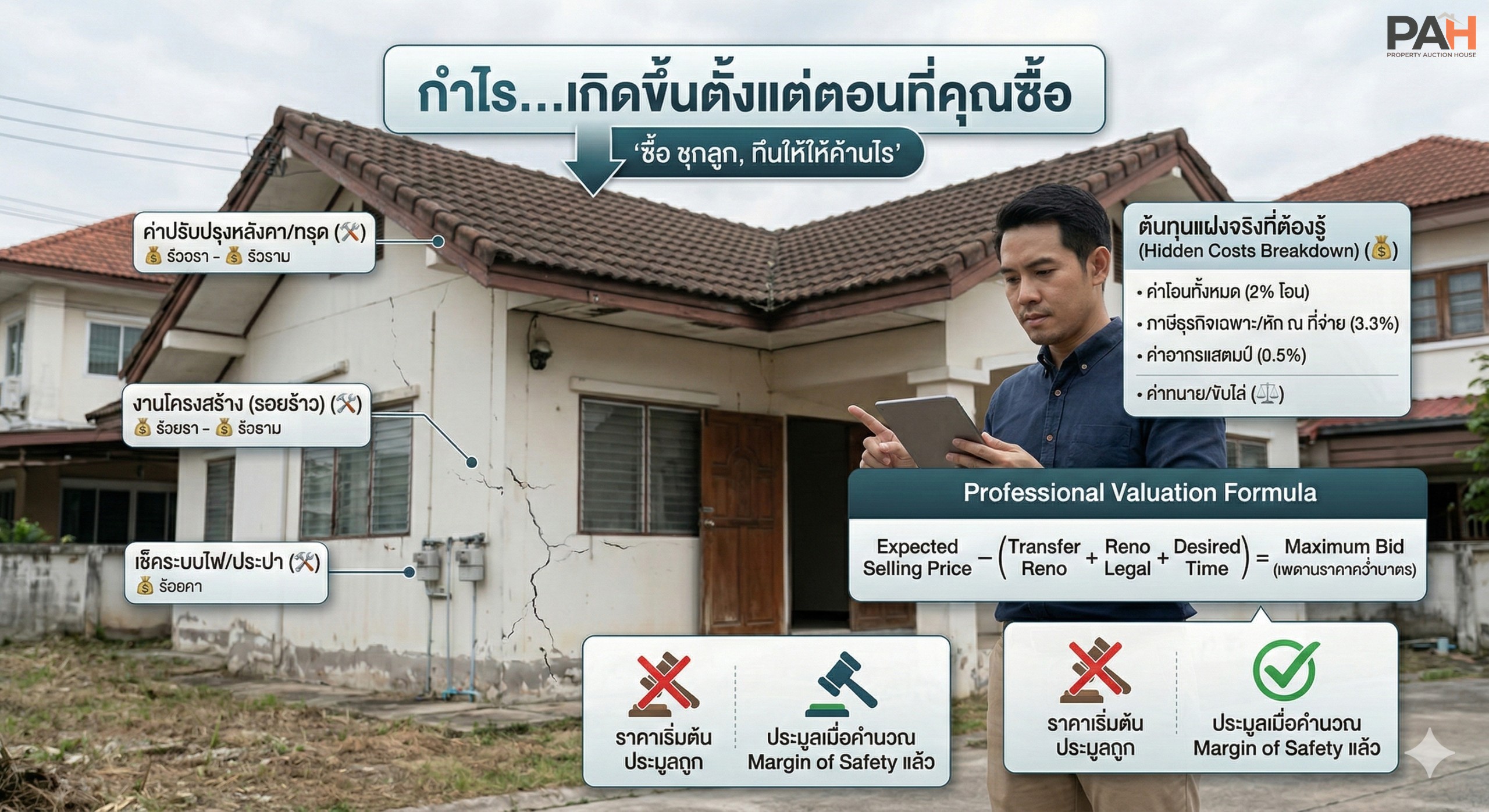
An auction price that seems cheap can instantly become expensive if you encounter escalating repair costs. The property condition is essentially a "Hidden Cost" that you must assess accurately.
🏠 Exterior Inspection
Structure: Look for cracks, subsidence, or if the house is tilting.
Roof and Components: Eaves, gutters, leaks, doors, windows, and fences.
Access: Verify if it is a public road or Landlocked Land (Blind Land) that requires a Servitude (Right of Way).
🛠 Interior Inspection (If access is possible)
Water Damage: Water stains on ceilings, mold, and moisture on walls.
Systems: Main breaker box, old wiring, plumbing, and sanitary ware drainage.
Pests: Traces of termites eating door frames or floor skirting.
Caution: If you cannot enter to inspect the interior, always set a renovation budget higher than usual.
3. Valuation Before the Real Fight
Do not get carried away by a tantalizingly low starting price, because that is not the only number you will pay. Professional investors calculate total costs as follows:
Final Bid Price: The price you expect to win at.
Fees: Transfer fees, Income Tax, Stamp Duty (at the Land Office).
Renovation: Repair, improvement, and decoration costs.
Time Cost: Bank interest (if borrowing) or opportunity cost of capital.
Legal Costs: Lawyer fees and court fees (in case an eviction lawsuit is needed).
Investor's Secret Formula: The appropriate final bid price should not exceed 60–70% of the market price to ensure a margin that covers all risks.
4. Steps After Winning the Auction
Once the hammer falls and the sale is yours, immediate actions are:
Payment: Pay the remaining balance within the specified timeframe (late payment results in deposit forfeiture).
Collect Documents: Contact the LED to receive the ownership transfer letter.
Transfer Ownership: Take the documents to register at the Land Office.
5. Crucial Highlight: The House is Empty, but "Freebies" (Old Belongings) Remain
This is where buyers make the most mistakes and risk jail time! Even though you are the legal owner of the house, the belongings inside still belong to the previous owner.
❌ ABSOLUTELY DO NOT:
DO NOT break in to move items yourself.
DO NOT throw away, destroy, or sell the belongings.
✅ Legally Correct Steps:
Record Evidence: Take photos/videos of the property condition.
File a Court Petition: Request an eviction execution warrant and removal of property.
Official Execution: Let the Legal Execution Officer handle the removal per court order.
Asset Management: If the previous owner does not claim the items within the deadline, the court will order those items to be auctioned to pay for the expenses.
Conclusion
Auctioning a home from the Legal Execution Department is not scary if you have the right knowledge. Good preparation regarding reading announcements, assessing property conditions, and understanding legal requirements will help you possess high-quality